
Body shop calls: estimates, insurance questions and drop-offs
How a collision repair shop can answer every call with an AI receptionist: what it answers about estimates and insurance from your facts, how it books estimate and drop-off times, what it leaves to your team and which calls reach a person straight away.
Why body shop calls are different
Most people who call a body shop have just had a bad day. The car is dented or won’t drive, the insurer has sent them a claim number and a list of steps, and they want to know what happens next. They tend to call more than one shop, and the first one that answers clearly often gets the job.
At the same time, the person who could answer is usually busy. Your estimator is walking around a car with a tablet, the front desk is handing keys to a customer, and the phone rings out. Adjusters, rental companies and tow drivers call too, and their calls get lost in the same pile.
An AI receptionist picks up every call on your shop’s number, day and night. It answers the questions your shop answers every day, books estimate and drop-off times, and turns everything that needs your team into a clear callback request.
What it can answer from your facts
WiseUnit answers from the facts, website pages and documents you add and approve. For a body shop, a short page of facts covers most first calls:
Write these the way you would explain them to a new hire. For a step-by-step guide, see how to train an AI receptionist on your business.
- “How do estimates work?” Whether you write estimates by appointment or during walk-in hours, how long one usually takes and what to bring, such as the claim number if there is one.
- “Do you work with my insurance?” The insurers you work with and how your shop handles claims, in the words you use at the counter.
- “My car doesn’t drive. What do I do?” The towing company you work with, its number and whether you accept cars after hours.
- “Will I get a rental car?” Your rental or loaner arrangements, if you have any.
- “When do I pay the deductible?” Your payment rules and the payment methods you accept.
Book estimates and drop-offs during the call
Once the caller knows how it works, the next step is usually a time. WiseUnit books into Google Calendar, Calendly or Cal.com, using the free slots you set for estimates and drop-offs. Calendly needs a paid Calendly plan, and Calendly and Cal.com both need the caller’s email address.
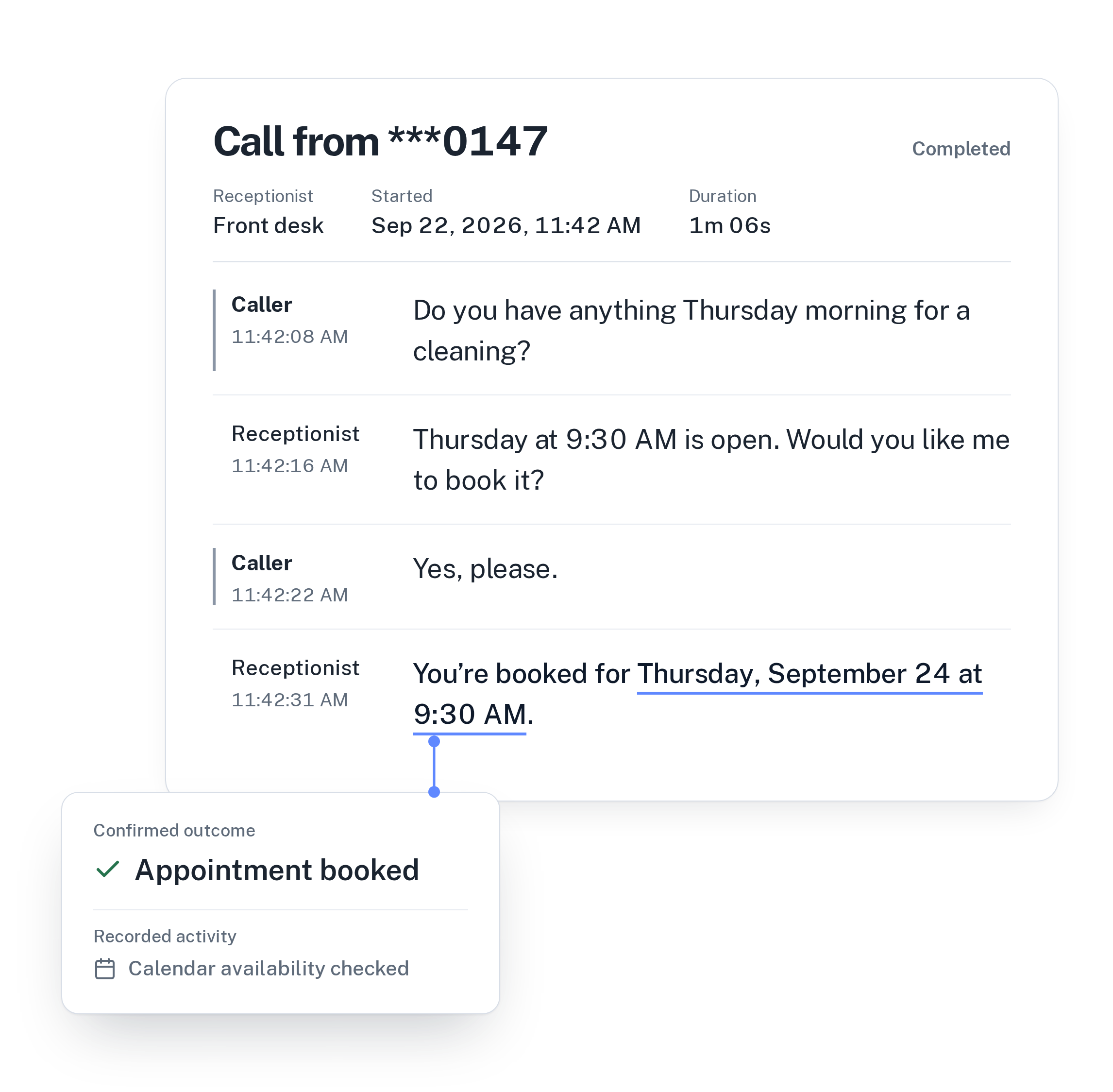
The receptionist confirms an appointment only once the booking exists in your calendar. If the slot is gone, it offers another one instead of promising a time you can’t keep. The caller hangs up with a day and time, and your estimator sees the appointment without having touched the phone.
What it leaves to your team
Some questions only your team can answer. The receptionist can’t look at the damage, so it won’t guess what a repair will cost. It doesn’t look into your shop management system or an insurer’s portal, so it can’t tell a caller where a claim stands or when their car will be finished.
For these calls it records a callback request with the reason, the caller’s preferred callback time and a priority. Tell it which details to collect, for example the name, the make and model, the insurer and the claim number. Your team then calls back once, with everything in front of them.
Questions about cars already in the shop work the same way. Read how to handle “is my car ready?” calls for the callback rules that work for status calls.
The calls that should reach a person
A tow driver at your gate, a customer standing next to a car that won’t start or an adjuster who needs an answer before the end of the day may not want to wait for a callback. Each receptionist has one transfer number, and your instructions decide which situations are put through to it.
Transfers can also be allowed after hours. If someone on your team is happy to take tow-in calls in the evening, the receptionist can put those calls through and take a callback request for the rest.
Rules that sort the callback list
A callback list is only useful if the top of it is the call to make first. Give the receptionist simple rules in plain language:
For more on writing these rules, see callback requests: getting messages you can act on.
- High priority for adjusters, tow-ins and customers whose car is not drivable.
- Normal priority for new estimate questions that couldn’t be booked during the call.
- Always ask for the make and model, the insurer and the claim number if the caller has one.
- If the caller mentions injuries or a police report, write it in the reason and leave the rest to your team.
See what callers asked
Every call is saved in your call history with a transcript, a summary and a confirmed outcome, such as “Appointment booked” or “Callback requested”. Call analytics show how many calls came in and how they ended.
The list of unanswered questions shows what callers asked that your facts didn’t cover, such as whether you repair aluminum panels or work on Saturdays. Approve an answer once and the receptionist uses it from then on. Changes stay in draft until you publish them, so you can test new wording with a call to your own number first.
Getting started
Connect a phone number, add your estimate process, insurers, towing partner and payment rules, connect your calendar, set the transfer number and publish. Then call your own shop and ask how to get an estimate after a fender bender.
WiseUnit plans start at €119 a month excluding VAT, or €99 a month on annual billing, with 1,000 included minutes on Starter. Business costs €359 a month, or €299 on annual billing, with 3,500 minutes. Every plan includes unlimited receptionists.
See how it works for repair shops and dealerships on the automotive page, or compare plans on the pricing page.
Frequently asked questions
Can the AI receptionist give a price for a repair?
No. It can’t see the damage, so it doesn’t quote repair prices. It explains how your estimates work from your facts, books an estimate appointment or records a callback request.
Can it tell a caller where their insurance claim stands?
No. WiseUnit doesn’t look into insurer portals or your shop management system. It records a callback request with the details you ask for, such as the insurer and claim number, or transfers the call if your instructions say so.
Can tow drivers and adjusters reach a person?
Yes, if you set it up that way. Each receptionist has one transfer number, your instructions decide which calls are put through, and transfers can be allowed after hours.
How much does it cost?
Plans start at €119 a month excluding VAT, or €99 a month on annual billing, with 1,000 included minutes on Starter and unlimited receptionists on every plan.