Maintenance is a decision process
A resident reports a leaking faucet.
Most people think what happens next is simple.
Someone reads the ticket.
Someone calls a plumber.
The plumber arrives.
The repair gets completed.
The work order closes.
In reality, that's almost never what happens.
Before a vendor is ever contacted, a property management company makes dozens of operational decisions.
Some happen automatically.
Some follow company policies.
Some depend on experience.
Some depend on budget.
Some depend on vendor performance.
Some depend on urgency.
Every one of those decisions affects:
- - maintenance cost
- - repair speed
- - resident satisfaction
- - vendor performance
- - operational workload
That's why maintenance isn't simply a repair process.
It's a decision process.
The biggest misconception in property management maintenance
Most people think maintenance starts when a vendor is dispatched.
We think it starts much earlier.
It starts with the first decision.
Every maintenance request asks questions before anyone schedules a repair.
Questions like:
- - Is this actually a maintenance issue?
- - Is it an emergency?
- - Which trade is required?
- - Do we have enough information?
- - Should we dispatch immediately?
- - Do we need multiple quotes?
- - Does this require approval?
Those decisions happen in seconds.
Or they happen over several days.
The quality of those decisions often determines the quality of the maintenance outcome.
Not the repair itself.
Maintenance is really a decision tree
Imagine every maintenance request entering the same point.
From there, the request branches into different paths depending on the answers to a series of questions.
It looks less like a work order.
And more like this.
Maintenance Request
↓
Decision
↓
Decision
↓
Decision
↓
Decision
↓
Vendor Dispatch
↓
Repair
↓
Completion
Most Property Management Systems record what happened.
Very few help coordinate the decisions that determine what should happen next.
That's where operational intelligence becomes valuable.
Introducing Maintenance Decision Intelligence
Every article in this series has introduced a different way to think about maintenance.
- - Maintenance Execution Gap
- - Operational AI
- - Maintenance Routing
- - Maintenance Resolution
- - Maintenance Backlog Intelligence
This article introduces another idea.
Maintenance Decision Intelligence
Maintenance Decision Intelligence is the process of making every operational decision consistently using company rules, historical data, vendor intelligence, pricing, and workflow logic.
Instead of asking:
"Who should we send?"
The better question becomes:
"What is the best operational decision at this point?"
Sometimes the answer is dispatch.
Sometimes it isn't.
Decision #1 — Is this actually a maintenance request?
It sounds obvious.
But not every incoming request requires a vendor.
Examples include:
- - resident education
- - duplicate requests
- - already scheduled repairs
- - warranty questions
- - appliance instructions
- - community policy questions
Dispatching a vendor immediately creates unnecessary work.
The first decision should always be:
Does this actually require maintenance?
If not, the workflow changes immediately.
Decision #2 — How urgent is it?
Not every repair deserves the same response.
A leaking ceiling.
A broken cabinet door.
An overflowing toilet.
A loose towel rack.
They all become maintenance requests.
They should not all become emergency dispatches.
This is where Maintenance Routing begins.
Questions include:
- - Is anyone in danger?
- - Could property damage increase?
- - Is the unit uninhabitable?
- - Can this wait until tomorrow?
- - Can it be grouped with other work?
The answer determines the operational path.
Not just the response time.
Decision #3 — Which trade is actually needed?
This sounds simple.
It often isn't.
A resident reports:
"There's water on my kitchen floor."
Is it:
- - plumbing?
- - HVAC condensation?
- - appliance repair?
- - roofing?
- - foundation seepage?
Dispatching the wrong trade creates delays before work even begins.
The better the diagnosis...
The better the first dispatch.
Decision #4 — Do we have enough information?
Many delays happen because the maintenance team starts too early.
Not too late.
Before dispatching anyone, the company should ask:
Do we have:
- - photos?
- - videos?
- - resident description?
- - unit information?
- - previous repair history?
- - access instructions?
If critical information is missing, the next operational step may not be dispatch.
It may be gathering more information first.
A five-minute clarification today can prevent a second vendor visit tomorrow.
Decision #5 — Has this happened before?
This is one of the most overlooked questions in maintenance.
Imagine two identical work orders.
One is the first time.
The other is the fourth time the same issue has been reported.
Those should not follow the same workflow.
Repeat issues may indicate:
- - incorrect diagnosis
- - poor workmanship
- - aging equipment
- - recurring plumbing problems
- - warranty opportunities
- - vendor quality issues
Maintenance history changes future decisions.
Every previous repair should make the next decision smarter.
Decision #6 — Is this covered by warranty?
Sending a vendor immediately might be the wrong decision.
Before scheduling work, companies should know:
- - Is the appliance under warranty?
- - Is the building component covered?
- - Is there an active service contract?
- - Is another company responsible?
Ignoring warranty information can create unnecessary maintenance costs.
Good operational decisions protect budgets before they create invoices.
Decision #7 — Which vendor is the best fit?
Many companies ask:
"Who's available?"
A better question is:
"Who's the best fit for this repair?"
The answer may depend on:
- - trade
- - location
- - response time
- - historical quality
- - compliance
- - resident preference
- - vendor capacity
- - previous experience at the property
The cheapest vendor isn't always the best decision.
The fastest vendor isn't always the best decision.
The goal is selecting the vendor most likely to produce the best overall outcome.
Decision #8 — Should multiple quotes be requested?
Not every repair requires competitive bidding.
Replacing a broken light switch probably doesn't.
A major HVAC replacement probably does.
The company should consider:
- - repair value
- - company policy
- - owner requirements
- - historical pricing
- - urgency
- - vendor availability
Sometimes immediate dispatch creates the most value.
Sometimes collecting multiple quotes creates the greatest long-term savings.
The decision isn't whether multi-bidding is good.
The decision is when multi-bidding creates value.
One maintenance request. Eight decisions already.
Notice something interesting.
We haven't contacted a vendor yet.
We haven't scheduled an appointment.
We haven't sent an approval.
We haven't updated the resident.
We've simply made eight operational decisions.
That's why maintenance coordination is much more complex than many people realize.
Every work order is really a chain of decisions.
And the quality of those decisions shapes everything that happens next.
Decision #9 — Is the quote reasonable?
The first quote isn't automatically the right quote.
Neither is the cheapest.
Before approving a repair, maintenance teams should ask:
- - Is this consistent with similar repairs?
- - Has this vendor charged similar amounts before?
- - Does the quote include everything?
- - Is labor unusually high?
- - Is the repair scope complete?
- - Is another estimate worth requesting?
This is where Vendor Intelligence becomes valuable.
Instead of looking at one quote in isolation, property managers can compare it against:
- - historical pricing
- - similar repair types
- - regional pricing patterns
- - previous work completed
- - vendor history
The goal isn't to challenge every invoice.
The goal is to understand whether a quote is fair before work begins.
Decision #10 — Does this require approval?
Every company has different approval rules.
Some approve anything under $300.
Others require owner approval above $1,000.
Some emergency repairs bypass approval entirely.
The decision isn't simply:
Approve or don't approve.
It's:
Who should approve this repair, and when?
Waiting too long creates delays.
Approving too quickly creates unnecessary spending.
Good maintenance operations strike the right balance.
Decision #11 — Is this vendor compliant?
The vendor might offer the lowest quote.
That doesn't automatically make them the right choice.
Before dispatch, maintenance teams often verify:
- - insurance
- - licenses
- - certifications
- - vendor agreements
- - W-9 documentation
- - property-specific requirements
Imagine dispatching a vendor only to discover they can't perform the work because of expired insurance.
Now the entire workflow starts again.
A compliance check before dispatch prevents unnecessary delays later.
Decision #12 — When should the work actually happen?
Speed matters.
But so does timing.
A repair may depend on:
- - resident availability
- - vendor availability
- - property access
- - weather
- - other scheduled work
- - material delivery
Scheduling isn't simply choosing the earliest available appointment.
It's coordinating multiple calendars while minimizing delays.
Sometimes tomorrow is the right answer.
Sometimes next Tuesday creates a better overall outcome.
Decision #13 — How should the resident be informed?
Communication is part of maintenance.
Not something that happens after it.
Residents often want answers to simple questions.
Has someone accepted the job?
When will they arrive?
Do I need to be home?
Has the repair been approved?
What happens next?
Clear communication reduces uncertainty.
It also reduces follow-up calls.
Good maintenance isn't just about completing repairs.
It's about making residents feel informed throughout the process.
Decision #14 — What happens if the vendor doesn't respond?
This is where many workflows stop.
The coordinator sends a request.
Then waits.
And waits.
Then follows up.
Then waits again.
A better workflow asks another question.
If this vendor doesn't respond, what should happen next?
Should another reminder be sent?
Should another vendor be contacted?
Should the property manager be notified?
Should the job automatically escalate?
Every company has different policies.
The important part is that there is a policy.
Decision #15 — Has the repair actually been completed?
A vendor marks the job complete.
But is it?
Was the repair verified?
Were photos uploaded?
Was the resident informed?
Was documentation completed?
Was the invoice received?
Completion is more than changing a ticket status.
It means the operational workflow has reached its intended outcome.
Decision #16 — Did the repair solve the problem?
This is where our previous article comes back.
A completed repair isn't always a resolved repair.
The maintenance team should ask:
Did the resident report the same issue again?
Was another vendor required?
Was another visit scheduled?
Did the repair remain successful?
Closing a work order measures administration.
Resolving the issue measures maintenance quality.
Decision #17 — What should we learn from this repair?
This may be the most valuable decision of all.
Most maintenance systems stop learning the moment a ticket closes.
We think they should start learning.
Every repair creates operational intelligence.
Questions like:
- - Did the selected vendor perform well?
- - Was the quote accurate?
- - Was the repair completed on time?
- - Was another visit required?
- - Was the resident satisfied?
- - Did the actual invoice match the estimate?
- - Was this repair more expensive than similar jobs?
Every answer improves future decisions.
Every maintenance request becomes another piece of operational knowledge.
That's how good maintenance teams become great maintenance teams.
The Maintenance Decision Engine
Let's step back.
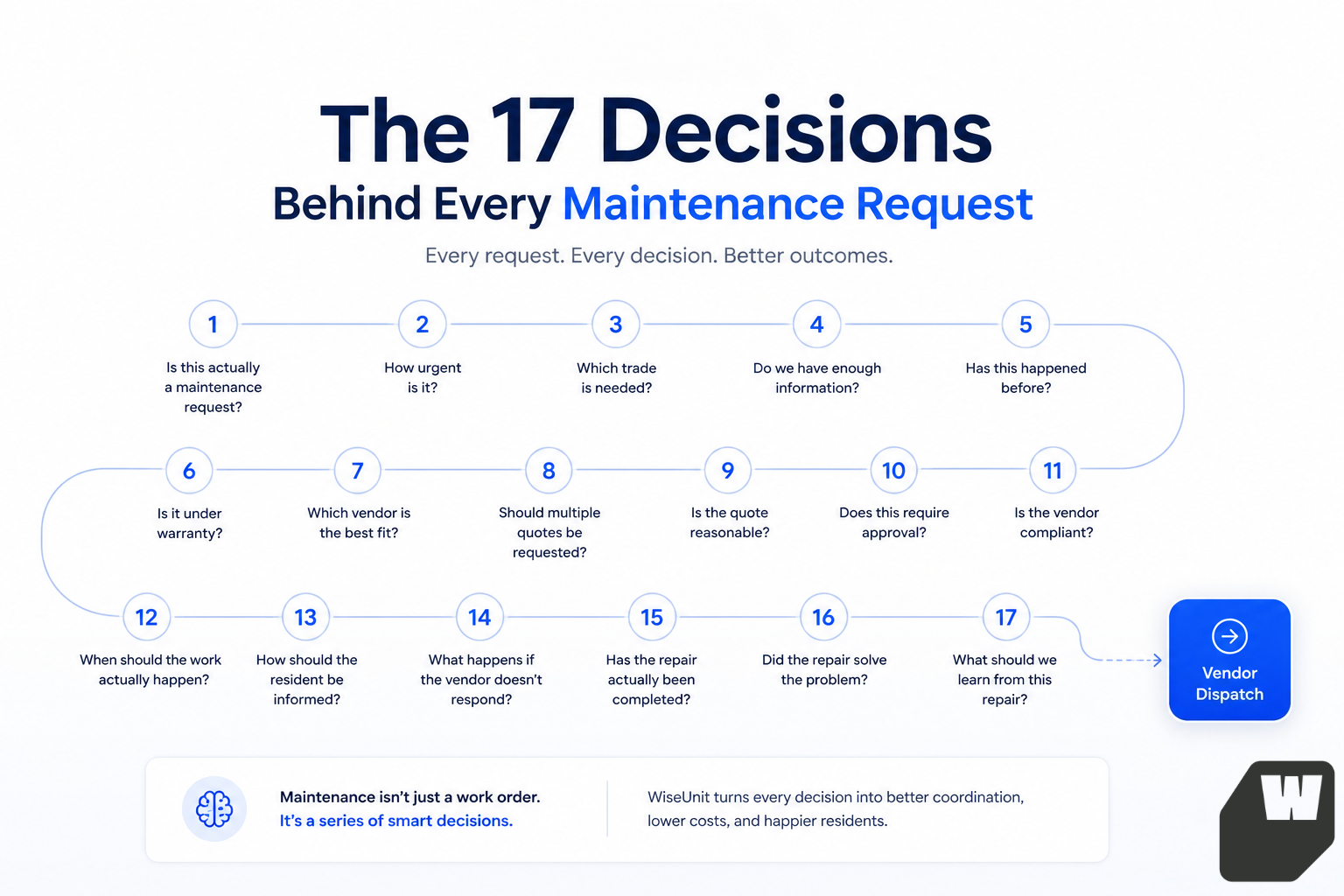
One maintenance request has now gone through seventeen decisions.
Not because maintenance is complicated.
Because good maintenance requires thoughtful coordination.
Here's what that decision engine looks like:
Maintenance Request
↓
1. Is it maintenance?
↓
2. How urgent is it?
↓
3. Which trade?
↓
4. Enough information?
↓
5. Repeat issue?
↓
6. Warranty?
↓
7. Best vendor?
↓
8. Multiple quotes?
↓
9. Quote reasonable?
↓
10. Approval needed?
↓
11. Vendor compliant?
↓
12. Schedule repair?
↓
13. Resident updates?
↓
14. Vendor responds?
↓
15. Repair completed?
↓
16. Problem resolved?
↓
17. What did we learn?
Seventeen decisions.
One maintenance request.
Most maintenance software records decisions.
It doesn't help make them.
Traditional systems are excellent at documenting maintenance.
They record:
- - work orders
- - invoices
- - notes
- - vendors
- - completion dates
But recording a decision isn't the same as supporting one.
Imagine opening a work order.
Most systems show you information.
They don't help answer questions like:
- - Should we request another quote?
- - Is this vendor usually expensive?
- - Has this issue happened before?
- - Is another vendor faster?
- - Should this repair skip approval?
- - Is this quote outside the normal range?
Those decisions still depend on people.
And people make hundreds of them every week.
How WiseUnit thinks differently
This is where WiseUnit is different.
WiseUnit wasn't built around tickets.
It was built around decisions.
Every maintenance request becomes a sequence of operational questions.
Each answer influences the next step.
Sometimes that means dispatching immediately.
Sometimes it means requesting another quote.
Sometimes it means escalating an approval.
Sometimes it means contacting a different vendor.
Sometimes it means waiting.
The goal isn't automation for the sake of automation.
The goal is helping maintenance teams make consistent operational decisions based on company rules, vendor intelligence, pricing history, and workflow logic.
That is what we call Maintenance Decision Intelligence.
Because maintenance isn't really a work-order system.
It's a decision engine.
The future of maintenance won't belong to the companies with the most vendors
It will belong to the companies that consistently make better decisions.
Think about every article we've written so far.
- - Maintenance Routing
- - Maintenance Resolution
- - Backlog Intelligence
- - Vendor Intelligence
- - Multi-Bidding
- - Operational AI
At first, they seem like separate ideas.
They're actually all connected.
They're all decisions.
Every maintenance request is simply a chain of operational decisions.
The better those decisions become, the better maintenance becomes.
Property Management Systems manage records
WiseUnit helps manage decisions.
This is an important distinction.
Your Property Management System should remain the source of truth.
It stores:
- - residents
- - units
- - vendors
- - work orders
- - accounting
- - leases
But once a maintenance request is created, another question immediately appears.
What should happen next?
That's not a record.
That's a decision.
Should another quote be requested?
Should the preferred vendor be bypassed?
Should the owner approve first?
Should this be dispatched immediately?
Should another vendor be contacted?
Should the resident be updated?
A Property Management System records what happened.
A Decision Engine helps determine what should happen next.
Maintenance is becoming a Decision Engine
Think about how AI has evolved.
The first generation answered questions.
The second generation automated repetitive tasks.
The next generation will make operational recommendations.
Not replacing people.
Supporting people.
Maintenance is the perfect example.
Most of the work isn't physical.
It's deciding.
Who?
When?
How?
At what cost?
According to which rules?
With which vendor?
Those decisions happen thousands of times every month.
That's why we believe maintenance is becoming a Decision Engine.
Every company already has a Decision Engine
It's just hidden.
Today it often lives inside:
- - spreadsheets
- - emails
- - Slack messages
- - phone calls
- - coordinator experience
- - manager memory
- - vendor relationships
Ask two coordinators how they would dispatch the same repair.
You might receive two completely different answers.
Not because one is wrong.
Because every person makes decisions differently.
Great operations shouldn't depend on memory.
They should depend on repeatable decision-making.
Consistency is a competitive advantage
Imagine managing 15,000 units.
Now imagine three regional offices.
Twenty coordinators.
Hundreds of vendors.
Thousands of maintenance requests every month.
Without consistent decision-making:
One office requests three quotes.
Another requests one.
One manager approves immediately.
Another waits three days.
One coordinator always follows up.
Another forgets.
The result is inconsistency.
Not because people aren't capable.
Because people naturally work differently.
A Decision Engine helps every office follow the same operational standards.
That creates consistency at scale.
Every repair should improve the next repair
This might be the biggest idea in this entire blog series.
Maintenance should learn.
Every completed repair should improve future decisions.
If Vendor A consistently responds in under one hour...
Future dispatches should know that.
If Vendor B regularly submits expensive quotes...
Future approvals should know that.
If a repair has failed three times...
Future workflows should know that.
If one property repeatedly experiences plumbing issues...
Future maintenance planning should know that.
Knowledge shouldn't disappear when a work order closes.
It should compound.
That's how maintenance operations become smarter over time.
From workflows to intelligence
Most software asks users to follow workflows.
We think the future looks different.
The workflow remains.
But intelligence sits on top of it.
Instead of asking:
"What should I click next?"
The system begins helping answer:
"What is the best next decision?"
That shift may seem small.
It isn't.
It changes maintenance from reactive coordination to intelligent execution.
Why this matters for property managers
Property managers don't wake up thinking about AI.
They think about:
Residents.
Owners.
Budgets.
Vendor performance.
Maintenance costs.
Team capacity.
Decision quality affects every one of those areas.
Better decisions often lead to:
- - better vendor selection
- - better pricing
- - fewer delays
- - fewer repeat repairs
- - less manual coordination
- - more consistent resident experiences
The goal isn't to automate judgment.
It's to support it.
Final thoughts
A maintenance request isn't simply a work order.
It's a sequence of decisions.
Should we dispatch?
Should we wait?
Should we approve?
Should we request another quote?
Should we contact another vendor?
Should we escalate?
Should we learn from this repair?
Those questions shape every maintenance outcome.
The companies that answer them consistently will outperform those that rely solely on manual coordination.
That's why we believe the future of property management isn't built around better tickets.
It's built around better decisions.
And that's exactly what WiseUnit was designed to support.
Not another dashboard.
Not another inbox.
A Maintenance Decision Engine that helps property management teams make smarter operational decisions from the moment a maintenance request is created until the moment the repair is truly resolved.
Frequently Asked Questions
- What is Maintenance Decision Intelligence?
- Maintenance Decision Intelligence is the practice of using operational rules, historical data, vendor performance, pricing intelligence, and workflow logic to help maintenance teams make more consistent decisions throughout the maintenance lifecycle.
- Why are there so many decisions behind one maintenance request?
- Every maintenance request involves decisions about urgency, trade selection, vendor choice, pricing, approvals, scheduling, communication, compliance, and verification before a repair is completed.
- How does WiseUnit support maintenance decisions?
- WiseUnit helps property management teams coordinate maintenance by supporting vendor selection, multi-bidding, quote comparison, approvals, scheduling, compliance tracking, resident communication, PMS updates, and operational follow-up according to company rules.
- Does WiseUnit replace Property Management Software?
- No. Your Property Management System remains the system of record. WiseUnit acts as an operational execution layer that helps coordinate and support maintenance decisions using the information already stored in your PMS.
- Why is decision quality important in maintenance?
- Better decisions can improve maintenance outcomes by reducing delays, supporting better vendor selection, improving pricing consistency, reducing repeat repairs, and helping teams coordinate work more efficiently.