Why closed work orders can hide unresolved problems
A maintenance ticket gets completed.
The vendor leaves.
The work order is marked "Closed."
Everything looks finished.
Three days later...
The resident calls again.
"The leak is back."
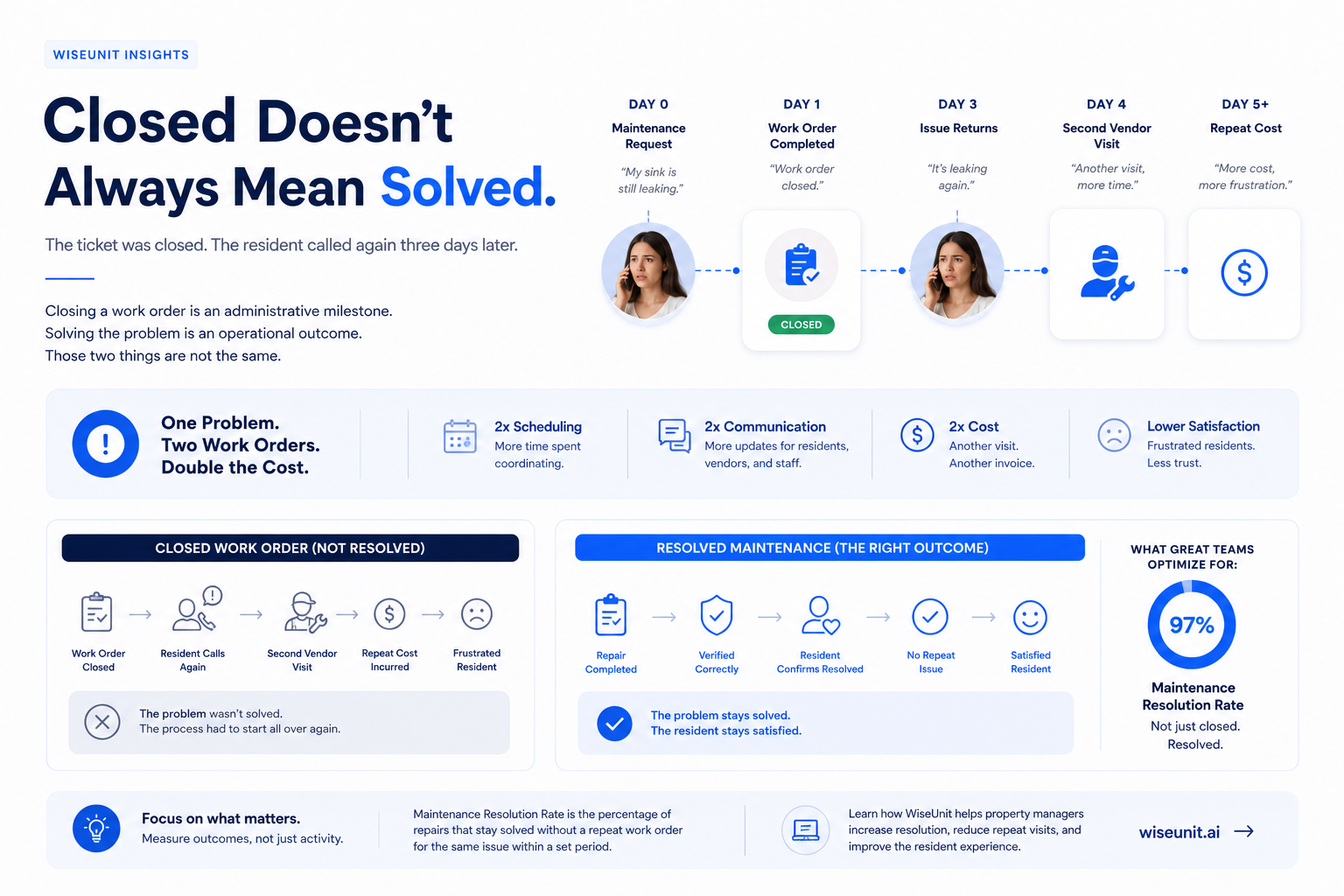
The ticket was closed.
The problem wasn't.
Those are two very different things.
Closing work is easy.
Solving problems is harder.
Most maintenance reports measure activity.
How many tickets were opened.
How many tickets were closed.
Average completion time.
Vendor response time.
Those are useful metrics.
But they don't answer one important question.
Did the repair actually solve the problem?
Because if the resident has to report the same issue again next week...
Was the original repair really completed?
A closed ticket isn't always a successful repair
Imagine a plumber repairs a leaking pipe.
The work order is closed.
Everyone moves on.
Two days later the leak returns.
Now what happens?
A new work order.
Another vendor visit.
Another scheduling process.
More resident frustration.
More staff coordination.
Potentially another invoice.
The original ticket may be closed.
The maintenance process isn't.
Every repeat visit has a cost
When repairs have to be repeated, the obvious cost is paying for another visit.
But that's only part of the story.
There are also hidden operational costs.
The maintenance coordinator has to reopen the issue.
Another vendor must be contacted.
Scheduling starts again.
The resident loses confidence.
Owners may question the quality of the repair.
Time that could have been spent solving new maintenance requests is now spent fixing an old one.
A repair completed twice is almost never cheaper than completing it correctly once.
The metric nobody talks about
Most companies celebrate completed work orders.
What if we measured something different?
Instead of asking:
How many tickets did we close?
Ask:
How many repairs stayed solved?
That small change shifts the focus from activity to outcomes.
It encourages better vendor selection.
Better quality control.
Better communication.
Better maintenance execution.
Introducing Maintenance Resolution Rate
We believe maintenance teams should measure more than completed work orders.
They should also measure Maintenance Resolution Rate.
Maintenance Resolution Rate measures how often a maintenance issue is fully resolved without requiring another work order for the same problem within a reasonable period of time.
A higher resolution rate often means:
higher repair quality
better vendor performance
fewer repeat visits
happier residents
less operational work
Closing tickets measures completion.
Resolution measures success.
The resident doesn't remember your workflow
Residents rarely know how many vendors were contacted.
They don't know how many approvals happened.
They don't know how many phone calls your maintenance coordinator made.
They remember something much simpler.
"Did my problem come back?"
If the answer is yes...
The maintenance experience probably wasn't a good one.
From the resident's perspective, the ticket was never truly finished.
One repair can become two
Let's compare two situations.
Scenario A
Leaking pipe.
↓
Vendor repairs issue.
↓
Resident confirms everything works.
↓
Problem never returns.
One work order.
One vendor visit.
One successful repair.
Scenario B
Leaking pipe.
↓
Vendor repairs issue.
↓
Ticket closed.
↓
Leak returns.
↓
Resident calls again.
↓
Second vendor visit.
↓
Second work order.
↓
Second invoice.
↓
Second scheduling process.
Same maintenance issue.
Twice the operational work.
Maintenance isn't complete until the problem stays solved
Closing a ticket is an administrative action.
Solving a maintenance problem is an operational outcome.
They're not always the same thing.
The best maintenance teams don't simply complete work orders.
They solve problems that stay solved.
That's a much higher standard.
And it's one worth measuring.
Introducing the Maintenance Resolution Framework
A work order has two possible endings.
The first is administrative.
The ticket gets closed.
The second is operational.
The problem stays solved.
Those aren't always the same outcome.
That's why we believe maintenance teams should think beyond work order completion.
They should focus on Maintenance Resolution.
What is Maintenance Resolution?
Maintenance Resolution means the underlying issue has been successfully fixed, allowing the resident to move forward without needing another repair for the same problem.
Notice what's missing.
It's not about how quickly the ticket was closed.
It's not about how many vendors were contacted.
It's not even about how fast someone arrived.
It's about one simple question.
Did the repair actually solve the problem?
The Maintenance Resolution Framework
Every maintenance request should move through four stages.
1. Repair
The issue is diagnosed and repaired.
↓
2. Verification
Confirm the work was completed correctly.
↓
3. Resident Confirmation
The resident confirms the issue has been resolved.
↓
4. Long-Term Resolution
The problem does not return.
Only then should the maintenance request be considered fully resolved.
Closed vs. Resolved
Let's compare two maintenance teams.
Team A
Vendor finishes the repair.
↓
Ticket closed.
↓
Next job.
From the system's perspective...
Everything looks successful.
Team B
Vendor finishes the repair.
↓
Repair verified.
↓
Resident confirms resolution.
↓
Vendor performance recorded.
↓
Issue remains resolved.
↓
Maintenance Resolution achieved.
Both teams closed the work order.
Only one confirmed the maintenance problem was actually solved.
Why repeat repairs happen
Not every repeat repair is caused by poor workmanship.
Sometimes the original issue wasn't diagnosed correctly.
Sometimes only the symptom was repaired.
Sometimes additional damage wasn't visible.
Sometimes the wrong parts were installed.
Sometimes communication between residents and vendors was incomplete.
Sometimes expectations were never confirmed.
That's why Maintenance Resolution should measure outcomes—not assumptions.
Every repeat repair creates operational debt
Think about everything that happens when a repair fails.
A new work order.
↓
Another maintenance coordinator reviews it.
↓
Another vendor is contacted.
↓
Another appointment is scheduled.
↓
Another resident update.
↓
Another invoice.
↓
Another trip.
↓
Another opportunity for frustration.
The repair itself may have taken thirty minutes.
The operational work surrounding it can consume hours.
Repeat repairs don't just increase maintenance costs.
They multiply coordination.
Resolution improves vendor intelligence
Every completed repair creates valuable information.
Did the issue stay fixed?
Did the resident call back?
Was another vendor required?
How many visits were needed?
Was the original diagnosis correct?
These aren't just maintenance questions.
They're vendor intelligence.
Over time, this data helps identify vendors who consistently deliver lasting repairs—not just fast repairs.
Speed without quality isn't efficiency
Imagine two vendors.
Vendor A
Completes jobs in one day.
But 20% of repairs require another visit.
Vendor B
Completes jobs in two days.
But almost every repair stays fixed the first time.
Which vendor is actually more efficient?
The answer isn't obvious until you look beyond work order completion.
Maintenance isn't just about speed.
It's about lasting outcomes.
The resident experience starts after the ticket closes
Many companies think the maintenance experience ends when the vendor leaves.
Residents think differently.
The real question begins afterward.
Does everything still work tomorrow?
What about next week?
Next month?
A maintenance request isn't remembered because someone clicked "Close."
It's remembered because the problem never came back.
AI can help improve Maintenance Resolution
AI can't tighten a pipe or replace an air conditioner.
People still perform the repair.
But AI can help improve everything around it.
It can help ensure:
the correct vendor is selected
repair history is available
previous repeat issues are visible
resident communication is consistent
completion is verified
vendor performance is continuously measured
The goal isn't simply completing work faster.
It's increasing the percentage of maintenance requests that stay solved.
Better maintenance isn't measured by closed tickets
Imagine two companies.
Company A closes 5,000 work orders.
Company B closes 4,500 work orders.
Which team performs better?
You can't answer from those numbers alone.
Now imagine this.
Company A has a Maintenance Resolution Rate of 82%.
Company B has a Maintenance Resolution Rate of 97%.
Suddenly the picture changes.
Because closing tickets measures activity.
Resolving problems measures quality.
The best maintenance teams optimize for outcomes
The best maintenance organizations don't celebrate closed work orders.
They celebrate repairs that never need to be repeated.
That's the difference between managing tickets and managing outcomes.
And that's why we believe Maintenance Resolution deserves to become one of the most important operational metrics in property management.
The future of maintenance isn't measured by closed tickets
For years, maintenance performance has been measured by operational activity.
How quickly did someone respond?
How many tickets were completed?
How many work orders were closed?
Those metrics still matter.
But they don't tell the whole story.
Because maintenance doesn't exist to close tickets.
It exists to solve problems.
As AI and operational intelligence become part of everyday property management, we believe the industry's definition of success will change.
The question won't be:
"How many work orders did we close?"
It will become:
"How many maintenance issues stayed solved?"
The resident experience is the real KPI
Residents don't know what happens behind the scenes.
They don't know:
how many vendors were contacted
how many reminders were sent
how many approvals were requested
how many internal notes were written
They remember something much simpler.
Did they have to report the same issue again?
If the answer is yes...
Everything your maintenance team did behind the scenes becomes less important.
From the resident's perspective, the repair failed.
That's why Maintenance Resolution isn't just an operational metric.
It's a resident experience metric.
Property Management Systems record maintenance. Maintenance Resolution measures maintenance quality.
Property Management Systems do an excellent job documenting maintenance activity.
They tell you:
when a ticket was created
who completed it
when it was closed
who performed the work
But another question still remains.
Was the repair successful?
That's where Maintenance Resolution fits.
It doesn't replace your Property Management System.
It complements it.
The PMS records the event.
Maintenance Resolution evaluates the outcome.
Together, they provide a much more complete picture of maintenance performance.
Resolution creates better vendor decisions
Every completed repair becomes another learning opportunity.
Imagine two HVAC vendors.
Both complete 100 work orders.
At first, they appear identical.
But after six months...
Vendor A has only two repeat repairs.
Vendor B has eighteen.
That's valuable operational intelligence.
Not because Vendor B is necessarily a bad vendor.
But because now your team has data that helps improve future decisions.
Maintenance Resolution doesn't just improve today's repair.
It improves tomorrow's vendor selection.
Better maintenance comes from better feedback
The strongest maintenance organizations don't simply complete work.
They learn from it.
Every repair answers important questions.
Did the resident call back?
Did the issue return?
Was another visit required?
Did another vendor ultimately solve the problem?
Those answers help maintenance operations continuously improve.
Without feedback, every work order starts from zero.
With feedback, every completed repair makes future repairs smarter.
Maintenance quality compounds over time
Imagine improving your Maintenance Resolution Rate by just a few percentage points each year.
Fewer repeat visits.
Fewer frustrated residents.
Less unnecessary coordination.
More confidence in vendor performance.
More predictable maintenance costs.
None of those improvements happen overnight.
But together they create something much more valuable.
A maintenance operation that gets better every month because it continuously learns from previous repairs.
That's the real advantage of operational intelligence.
A completed repair should create confidence
When a resident sees a work order marked Completed, they shouldn't wonder whether they'll need to report the same issue again next week.
They should feel confident the problem is behind them.
That's what great maintenance creates.
Not simply completed tickets.
Confidence.
Confidence that the repair was done correctly.
Confidence that the right vendor was selected.
Confidence that the issue won't return.
That confidence is what residents remember.
Final thoughts
Closing a work order is an administrative milestone.
Solving the maintenance issue is an operational outcome.
Those two things should never be confused.
The best maintenance teams don't optimize for how many tickets they can close.
They optimize for how many problems they can permanently solve.
Because the goal of maintenance isn't to complete work orders.
It's to make sure residents never have to submit the same one again.
That's why we believe Maintenance Resolution Rate will become one of the most important metrics in the future of property management.
Frequently Asked Questions
- What is Maintenance Resolution?
- Maintenance Resolution measures whether a maintenance issue was fully solved—not simply whether the work order was closed. A resolved repair means the issue remains fixed without requiring another work order for the same problem within a defined period.
- Why isn't a closed work order enough?
- Closing a work order only confirms that the administrative process ended. It doesn't guarantee the underlying maintenance issue was successfully resolved.
- What causes repeat maintenance requests?
- Repeat repairs can occur for many reasons, including incomplete repairs, incorrect diagnoses, recurring equipment failures, communication gaps, or unresolved underlying issues.
- What is Maintenance Resolution Rate?
- Maintenance Resolution Rate measures the percentage of maintenance requests that remain successfully resolved without requiring a repeat repair. It helps organizations evaluate repair quality instead of simply measuring completed work orders.
- How can AI improve Maintenance Resolution?
- AI can support better outcomes by helping maintenance teams select the right vendors, surface repair history, identify repeat issues, coordinate communication, verify completion, and continuously measure repair quality over time.