Why maintenance requests need different workflows
Imagine these three maintenance requests arrive at exactly the same time.
A leaking pipe.
A broken kitchen cabinet.
A burned-out hallway light.
Each one creates a work order.
But should they all follow the exact same maintenance process?
Probably not.
Yet many property management teams still send every maintenance request through one standard workflow.
The result?
Critical repairs wait longer than they should.
Routine requests receive unnecessary attention.
Maintenance teams spend more time managing priorities than solving problems.
The problem isn't the work order.
The problem is assuming every work order deserves the same operational path.
Every maintenance request is different
Not every repair carries the same level of urgency.
Some issues threaten property damage.
Some affect resident safety.
Some are simply cosmetic.
Treating every request the same creates unnecessary delays for the issues that matter most.
Think about these examples.
Emergency:
A burst pipe flooding an apartment.
Urgent:
The air conditioning stops working during a heat wave.
Routine:
A loose cabinet handle.
Each repair deserves attention.
But not all deserve the same response.
One workflow creates bottlenecks
Many maintenance teams rely on a single process.
Resident submits request.
↓
Coordinator reviews it.
↓
Vendor contacted.
↓
Approval requested.
↓
Repair scheduled.
↓
Work completed.
The process is simple.
The problem is that every maintenance request enters the exact same line.
Imagine a hospital.
Would someone with a paper cut wait in the same queue as someone having a heart attack?
Of course not.
Hospitals use triage.
Maintenance should too.
Maintenance isn't just about fixing problems
It's about deciding how each problem should be handled.
Every incoming work order asks several questions.
How urgent is this?
Does it require immediate dispatch?
Should multiple vendor quotes be collected?
Does it need owner approval?
Can it wait until next week?
Should a preferred vendor always be used?
These decisions happen before anyone picks up a wrench.
That's where operational efficiency begins.
The hidden cost of poor prioritization
When every maintenance request follows the same workflow, several things happen.
Emergency jobs wait behind routine requests.
Maintenance coordinators spend valuable time manually deciding priorities.
Vendors receive incomplete information.
Residents become frustrated.
Owners experience avoidable delays.
The issue isn't that maintenance teams don't work hard.
It's that the workflow doesn't adapt to the situation.
Introducing Maintenance Routing
Just as we introduced the Maintenance Execution Gap and Operational AI, this article introduces another concept:
Maintenance Routing
Maintenance Routing is the process of automatically directing each maintenance request into the most appropriate operational workflow based on its characteristics.
Instead of asking:
"We received a maintenance request."
The better question becomes:
"What is the right workflow for this maintenance request?"
That small shift changes everything.
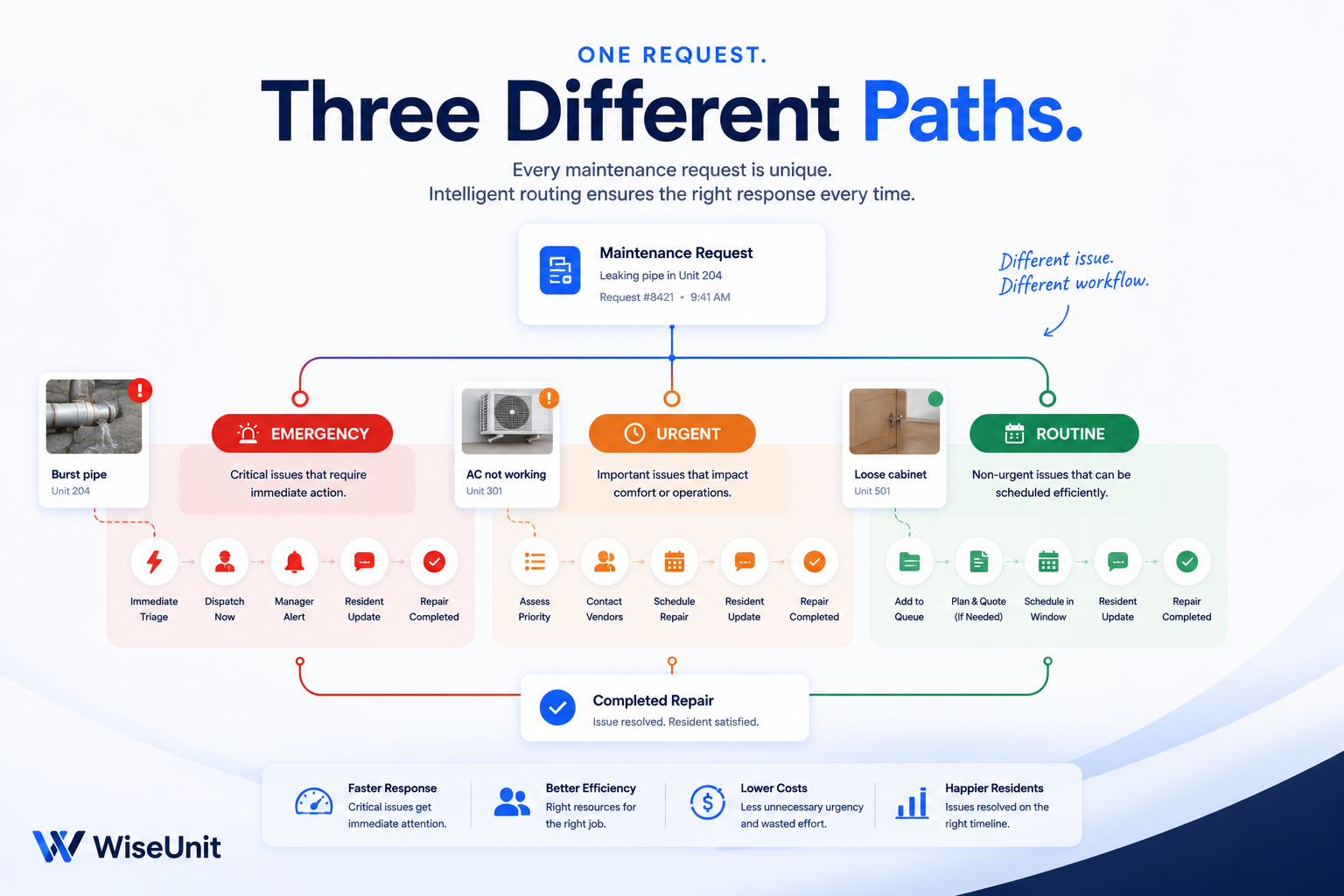
Three requests. Three different paths.
Imagine these three work orders arriving at the same time.
Emergency
A leaking water pipe.
Goal:
Protect people and property.
Typical workflow:
Immediate classification.
↓
Immediate vendor dispatch.
↓
Notify property manager.
↓
Resident receives updates.
↓
Repair completed.
Speed matters most.
Urgent
Air conditioning stops working.
Goal:
Restore comfort quickly.
Typical workflow:
Classify urgency.
↓
Contact preferred vendors.
↓
Schedule earliest availability.
↓
Keep resident informed.
↓
Complete repair.
Balance speed with coordination.
Routine
A damaged cabinet hinge.
Goal:
Complete efficiently.
Typical workflow:
Group with similar repairs.
↓
Collect quotes if needed.
↓
Schedule during regular maintenance window.
↓
Complete repair.
Efficiency matters more than urgency.
One ticket.
Three completely different workflows.
That's not complexity.
That's better operations.
The future of maintenance isn't faster.
It's smarter.
Most conversations about AI focus on speed.
Faster replies.
Faster scheduling.
Faster updates.
Those improvements matter.
But the bigger opportunity is making better operational decisions before work even begins.
The smartest maintenance teams won't simply move faster.
They'll route work more intelligently.
Because the fastest workflow isn't always the right workflow.
The right workflow depends on the maintenance request.
Introducing the Maintenance Routing Framework
Every maintenance request has one thing in common.
It starts with a resident reporting a problem.
Everything after that should depend on the type of issue.
That's where Maintenance Routing comes in.
Instead of sending every request through the same operational process, Maintenance Routing directs each work order into the workflow that best fits the situation.
Think of it like GPS.
No matter where you're going, your navigation app doesn't always choose the same road.
It chooses the best route based on the destination and current conditions.
Maintenance should work the same way.
The goal isn't one workflow.
The goal is the right workflow.
The Maintenance Routing Framework
Every incoming maintenance request should first answer one question:
What operational path should this request follow?
We believe most maintenance requests can be routed into one of three categories.
Emergency
These requests require immediate action.
Examples:
Burst pipe
Gas leak
Fire damage
No heat during freezing temperatures
Major electrical hazard
Priority:
Protect people and property.
Typical workflow:
Immediate triage.
↓
Immediate vendor dispatch.
↓
Manager notified.
↓
Resident updated.
↓
Repair completed.
Urgent
These issues affect livability but usually don't require emergency dispatch.
Examples:
Air conditioning failure
Water heater not working
Refrigerator failure
Broken exterior door
Plumbing blockage
Priority:
Restore normal living conditions quickly.
Typical workflow:
Identify preferred vendor.
↓
Schedule earliest availability.
↓
Notify resident.
↓
Complete repair.
Routine
Routine work keeps properties maintained but doesn't require immediate attention.
Examples:
Loose cabinet handle
Minor drywall repair
Touch-up paint
Running toilet
Window screen replacement
Priority:
Complete efficiently.
Typical workflow:
Batch with similar work.
↓
Collect quotes if needed.
↓
Schedule during regular maintenance window.
↓
Complete repair.
Why one workflow creates unnecessary work
Let's compare two maintenance teams.
Team A
Every work order enters the same process.
Every request receives the same review.
Every request follows the same approval path.
Every request follows the same vendor process.
The team spends a large part of the day deciding what should happen next.
Team B
Every request is classified first.
Emergency work moves immediately.
Urgent work follows accelerated coordination.
Routine work is scheduled for maximum efficiency.
Instead of constantly reorganizing maintenance...
The workflow organizes itself.
Good routing improves everyone’s experience
Maintenance Routing doesn't just help property managers.
It benefits everyone involved.
Residents
Emergency issues receive faster attention.
Routine requests come with realistic expectations.
Communication improves because priorities are clear.
Maintenance Teams
Less manual prioritization.
Less administrative work.
More consistent execution.
More time spent solving problems instead of organizing them.
Vendors
Receive better information.
Know the urgency before arriving.
Can schedule work more efficiently.
Avoid unnecessary emergency dispatches.
Property Owners
Critical repairs happen sooner.
Routine work is completed more efficiently.
Resources are used where they create the most value.
Routing isn't only about urgency
Urgency is important.
But it's only one part of the decision.
A smart maintenance workflow can also consider:
Property rules
Preferred vendors
Spending limits
Owner approval requirements
Vendor availability
Historical vendor performance
Maintenance history
Compliance requirements
The workflow becomes smarter because it considers context—not just the maintenance issue itself.
AI makes Maintenance Routing scalable
At 100 units, a maintenance coordinator can usually prioritize work manually.
At 1,000 units, it becomes much harder.
At 10,000 units, every day brings dozens or even hundreds of new requests.
No matter how experienced your team is, manually reviewing every request becomes increasingly difficult.
This is where AI can help.
Instead of asking someone to manually evaluate every ticket, AI can help classify requests according to your company's operational rules.
It doesn't replace human oversight.
It helps ensure every request starts in the right workflow.
Maintenance Routing in action
Let's revisit our three maintenance requests.
Request 1
"Water is pouring from my ceiling."
The system recognizes the potential for property damage.
↓
Emergency workflow.
↓
Immediate vendor dispatch.
↓
Manager notified.
↓
Resident updated.
Request 2
"Our air conditioning stopped working."
The issue affects comfort but isn't causing immediate property damage.
↓
Urgent workflow.
↓
Preferred HVAC vendor contacted.
↓
Earliest appointment scheduled.
↓
Resident updated.
Request 3
"One kitchen cabinet door is loose."
The issue is important but not time-sensitive.
↓
Routine workflow.
↓
Grouped with other routine repairs.
↓
Scheduled efficiently.
↓
Resident informed.
Three requests.
Three different operational paths.
Exactly as they should be.
Smarter routing leads to smarter execution
The biggest benefit of Maintenance Routing isn't that it makes work faster.
It's that it makes work more appropriate.
Emergency issues receive emergency attention.
Routine issues don't consume emergency resources.
Maintenance teams spend less time deciding what to do next.
Residents receive more consistent service.
Vendors receive clearer expectations.
Execution improves because every request begins on the right path.
That's what modern maintenance operations should look like.
Routing is the first decision in maintenance execution
Before a vendor is contacted...
Before a quote is requested...
Before an approval is sent...
Before a repair is scheduled...
One decision matters most.
What workflow should this maintenance request follow?
If that first decision is wrong, every step afterward becomes harder.
If it's right, the rest of the maintenance process becomes significantly more efficient.
That's why we believe Maintenance Routing is one of the most overlooked parts of property management operations.
Maintenance is becoming more dynamic
Property management isn't getting simpler.
Resident expectations continue to rise.
Owners want more visibility.
Vendor networks continue to grow.
Maintenance costs fluctuate.
Labor shortages make scheduling more difficult.
Yet many maintenance workflows still assume every request should follow the same path.
That approach worked when portfolios were smaller.
It becomes much harder as operations grow.
The future isn't about creating one perfect workflow.
It's about having the right workflow for every situation.
One workflow can never fit every repair
Imagine if every package delivered by a shipping company followed the exact same route.
An overnight medical shipment.
A couch.
A birthday card.
A replacement phone.
Clearly, that wouldn't work.
Shipping companies route every package differently based on priority, destination, size, and delivery requirements.
Maintenance should work the same way.
Every repair has different priorities.
Different urgency.
Different approval rules.
Different vendor requirements.
Different business impact.
Routing those requests intelligently is what creates operational efficiency.
Maintenance Routing is the first step toward Operational AI
Throughout this series, we've introduced several ideas that build on one another.
First, we introduced the Maintenance Execution Gap—the work that happens between a maintenance request and a completed repair.
Then we explored Operational AI, showing that AI should do more than answer questions; it should help execute maintenance.
Now we've introduced Maintenance Routing.
These ideas are connected.
Maintenance Routing is the first operational decision.
Everything that follows—vendor selection, approvals, scheduling, communication, and completion—depends on getting that first decision right.
Execution doesn't begin when a vendor accepts a job.
It begins the moment a maintenance request is received.
Better routing creates better operations
The goal isn't simply to close tickets faster.
The goal is to use your team's time where it creates the most value.
Emergency work gets immediate attention.
Routine work gets scheduled efficiently.
Urgent work receives the right balance of speed and coordination.
That means:
fewer manual decisions
fewer unnecessary delays
more consistent execution
better use of vendor resources
clearer communication with residents
When the workflow adapts to the repair instead of forcing every repair into the same process, the entire maintenance operation becomes more predictable.
Property Management Systems record work. Maintenance Routing directs work.
Property Management Systems are excellent at recording maintenance requests.
They store:
residents
properties
vendors
work orders
maintenance history
But once a work order is created, another question appears:
What should happen next?
That's where Maintenance Routing fits.
It doesn't replace your Property Management System.
It complements it.
The PMS remains the system of record.
Maintenance Routing becomes part of the system of execution, helping each request move through the most appropriate operational path.
Small improvements become big results
Changing how a maintenance request is routed might seem like a small improvement.
But maintenance operations are built from thousands of small decisions.
Every correctly routed request saves a little time.
Avoids a little confusion.
Reduces a little manual work.
Improves communication just a little.
Multiply that across hundreds or thousands of maintenance requests every month, and those small improvements become meaningful operational gains.
Operational excellence rarely comes from one big change.
It comes from consistently making better decisions.
Maintenance Routing is one of those decisions.
Final thoughts
Not every maintenance request deserves the same response.
A burst pipe should never wait behind a cosmetic repair.
A loose cabinet hinge shouldn't consume emergency resources.
The best maintenance teams don't just complete work.
They decide how work should be completed.
That starts with routing every maintenance request into the right operational workflow.
Because smarter maintenance doesn't begin with dispatch.
It begins with deciding where the work should go.
Frequently Asked Questions
- What is Maintenance Routing?
- Maintenance Routing is the process of directing each maintenance request into the most appropriate workflow based on factors such as urgency, company policies, vendor requirements, approvals, and operational rules.
- Why shouldn't every maintenance request follow the same workflow?
- Different repairs require different responses. Emergency issues often require immediate action, while routine maintenance can be scheduled more efficiently. Using the same workflow for every request can create unnecessary delays and inefficient use of resources.
- What types of maintenance requests benefit from routing?
- Most maintenance requests can be grouped into categories such as Emergency, Urgent, and Routine, with each following a workflow designed for its level of priority and operational requirements.
- Can AI help with Maintenance Routing?
- Yes. AI can help classify incoming maintenance requests according to predefined business rules, allowing maintenance teams to begin the appropriate workflow more quickly while keeping managers in control of important decisions.
- Does Maintenance Routing replace Property Management Software?
- No. Property Management Systems remain the system of record. Maintenance Routing supports the system of execution by helping determine how maintenance requests should move through operational workflows.