
What a missed call costs your business, and how to work out your own number
General figures about missed calls describe other businesses. A four-step method to work out what unanswered calls cost yours, with a worked example and a way to check the estimate later.
Why a general figure won’t help you
Search for the cost of missed calls and you will find big numbers. They are averages from other businesses, other industries and other years. They can’t tell you what an unanswered call is worth to a plumbing company with two vans or a dental practice with one front desk.
The figure that matters is your own, and you can work it out in about an hour with records you already keep. You need four numbers.
The sum in one line
Missed calls a week × share from new customers × share that would have booked × value of a first booking = what missed calls cost you each week.
Multiply the result by 52 and divide by 12 for a monthly figure. The next four sections explain where each number comes from.
Step 1: count the calls you actually miss
Start with your phone provider’s call log or your phone system’s list of missed calls. Take one normal week, or better two, and count the calls nobody answered. Include calls that rang out, calls that went to voicemail and callers who hung up before leaving a message.
Count each number once per day. A caller who tries three times in ten minutes is one missed caller, not three. If you have no log, keep a tally next to the phone for a week. It will be rough, and rough is enough here.
Step 2: estimate how many were new customers
Not every missed call is lost business. Some are suppliers, some are sales calls, and some are existing customers who will try again. Go through the voicemails you got and the numbers you called back, and sort them roughly into new customers, existing customers and everything else.
Use the share of new customers in the sum. Existing customers matter too, but they rarely disappear after one missed call, so keep them out of the main number and treat them as a separate cost.
Step 3: estimate how many would have booked
Of the new callers you do answer, how many end up booking an appointment, a visit or a job? Your calendar or order book shows it. If you answer ten new callers and four of them book, your rate is four in ten.
Be a little cautious. Someone who reaches voicemail may already be less ready to book than someone you speak to, so if in doubt, use a lower rate than the one you see on answered calls.
Step 4: put a value on a first booking
Use the value of the first job or visit, not what a customer might be worth over the years. A first oil change, a check-up, a first treatment or a call-out fee is a figure you can check in last month’s invoices. If your work varies a lot, take the average of your last twenty first bookings.
What a customer is worth over the years is real, but it makes the result easy to inflate. Keep it as a side note. If the weekly figure is already clear with first bookings only, you don’t need it.
A worked example
Here is the sum with made-up numbers for a small repair shop. They show how the method works; they are not a benchmark for your business.
- 12 missed calls in a normal week.
- Half of them from new customers: 6 callers.
- Half of those would have booked: 3 jobs.
- A first job is worth €150 on average: €450 a week.
What the sum leaves out
Over a year, that example comes to €23,400, or €1,950 a month. And it still leaves out costs that are harder to put a number on:
- The time spent returning calls, reaching voicemail and calling again.
- Existing customers who give up after a few tries and go elsewhere.
- The work you interrupt when you do pick up in the middle of a job.
Comparing it with what answering costs
Now put your number next to the cost of answering those calls. WiseUnit starts from €119 a month, or €99 a month on annual billing, excluding VAT. Starter includes 1,000 minutes of calls, Business 3,500 and Scale 7,000, and every plan includes unlimited receptionists.
The AI receptionist answers every call on the phone number you connect, 24 hours a day. It answers questions from the facts, website pages and documents you approve. It books into Google Calendar, Calendly or Cal.com and confirms only once the booking exists. Urgent calls go to your transfer number, and the rest end as callback requests with a reason, a preferred callback time and a priority.
For a full breakdown of plans and minutes, read what an AI receptionist costs.
Replace the estimate with real numbers
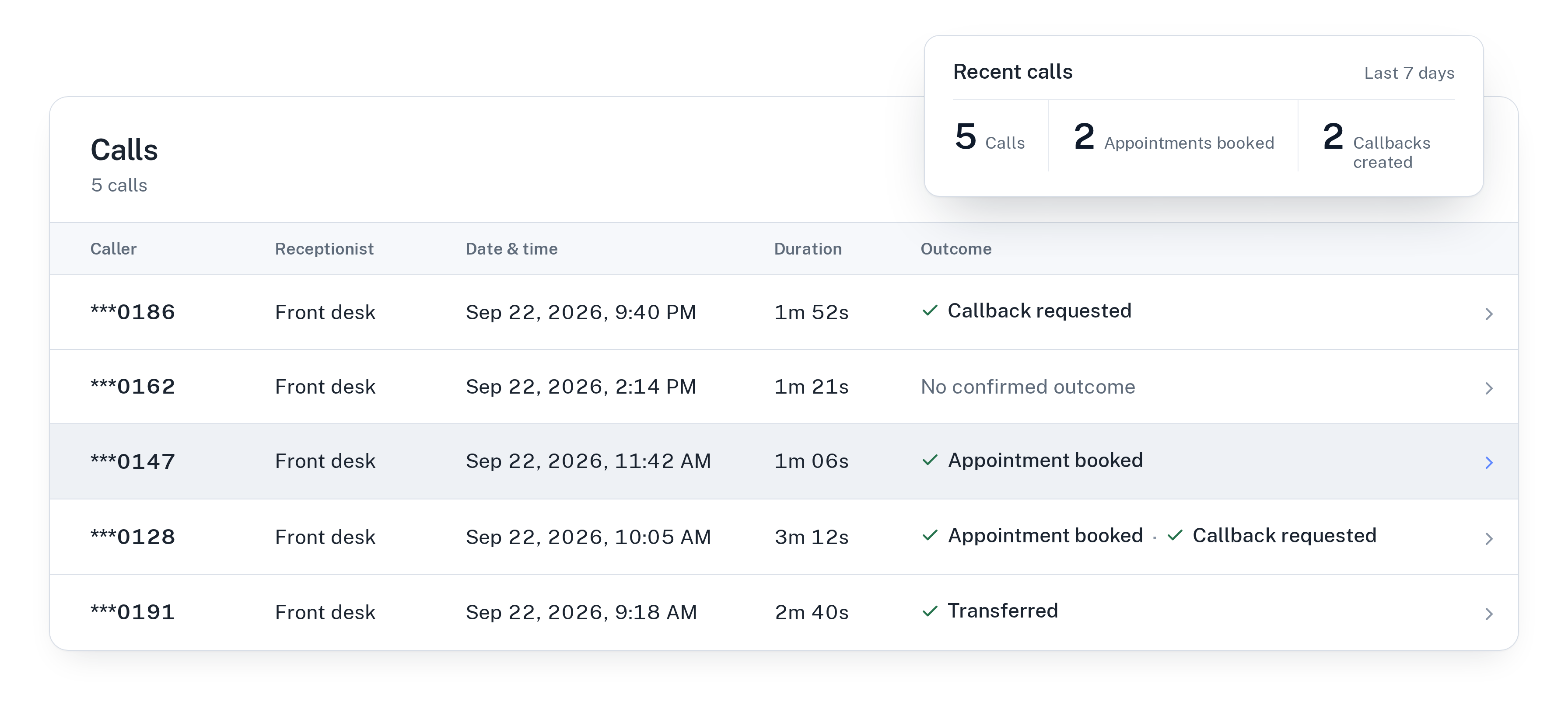
An estimate is a starting point. Once calls are answered, you can stop guessing. Every call in WiseUnit has a transcript, a summary and a confirmed outcome, such as appointment booked, transferred or callback requested, and call analytics show those outcomes over time.
After a few weeks, count the bookings that came in while you were busy or closed and multiply them by your first-booking value. That is the part of your missed-call cost you no longer pay. Questions the receptionist couldn’t answer show up as unanswered questions, which you can turn into answers to approve.
If most of your missed calls come in during the working day, read how to stop losing callers when your phone is busy.
Frequently asked questions
What if I don’t have a call log?
Keep a tally next to the phone for one normal week, or ask your phone provider whether it can show unanswered calls. A rough count is enough to tell whether the cost is small or large.
Should I include calls from existing customers?
Keep them out of the main sum, because many of them will call again. Count them separately: if existing customers often give up after a missed call, that is a cost on top of the figure for new customers.
How do I check whether an AI receptionist pays for itself?
Compare your monthly figure with the plan price, from €119 a month excluding VAT. After you switch it on, the call history shows each call’s confirmed outcome, so you can count the bookings and callbacks it handled instead of relying on the estimate.