Property Management's Biggest Maintenance Problem
AI has become one of the biggest topics in property management.
Almost every week there's a new company promising an AI receptionist.
An AI leasing assistant.
An AI phone agent.
An AI maintenance chatbot.
Most of them are impressive.
They answer questions instantly.
They reduce missed calls.
They book tours.
They create maintenance tickets.
They summarize conversations.
These tools solve an important problem.
But they don't solve the biggest one.
Because property management's biggest maintenance problem isn't communication.
It's execution.
At WiseUnit, we believe the industry is asking the wrong question.
Instead of asking,
"Can AI answer residents faster?"
we should be asking,
"Can AI actually get the maintenance work completed?"
Those are completely different challenges.
The industry has focused on the front door
Imagine a resident submits a maintenance request.
"My kitchen sink is leaking."
Most AI systems do something like this:
✓ Understand the request.
✓ Respond politely.
✓ Create a maintenance ticket.
✓ Tell the resident someone will follow up.
Conversation complete.
From the resident's perspective, that's helpful.
But from the operations team's perspective...
Almost nothing has changed.
The real work hasn't even started.
Someone still has to:
- - decide whether it's urgent
- - identify the right trade
- - contact vendors
- - request quotes
- - compare pricing
- - follow up
- - schedule the repair
- - request approval
- - update the PMS
- - notify the resident
- - monitor completion
The chatbot handled the conversation.
The maintenance team still handles the operation.
The conversation isn't the maintenance
This is one of the biggest misconceptions in property management AI.
People often confuse the conversation with the work.
They're not the same thing.
Think about ordering food.
Placing the order is easy.
Preparing the meal.
Cooking it.
Packaging it.
Delivering it.
Those are the difficult parts.
Maintenance works exactly the same way.
Submitting the request takes seconds.
Executing the repair may take days.
That is why we believe AI should focus less on the conversation...
...and more on everything that happens afterward.
Introducing a new way to think about AI
We think AI in property management is beginning to split into two categories.
Conversational AI
Its job is communication.
Examples include:
- - answering resident questions
- - voice assistants
- - maintenance chatbots
- - leasing assistants
- - phone receptionists
- - email assistants
These systems are designed to communicate.
They are extremely valuable.
But communication isn't execution.
Operational AI
Operational AI has a different responsibility.
Instead of talking...
It gets work done.
For maintenance, that means helping execute the operational workflow after a request has been created.
For example:
- - vendor coordination
- - intelligent dispatch
- - multi-bidding
- - quote collection
- - quote comparison
- - compliance verification
- - scheduling
- - approval routing
- - PMS updates
- - resident updates
- - vendor scoring
- - pricing intelligence
Conversation is only one small part of that workflow.
Execution is everything else.
Most AI stops where the real work begins
Let's compare the two approaches.
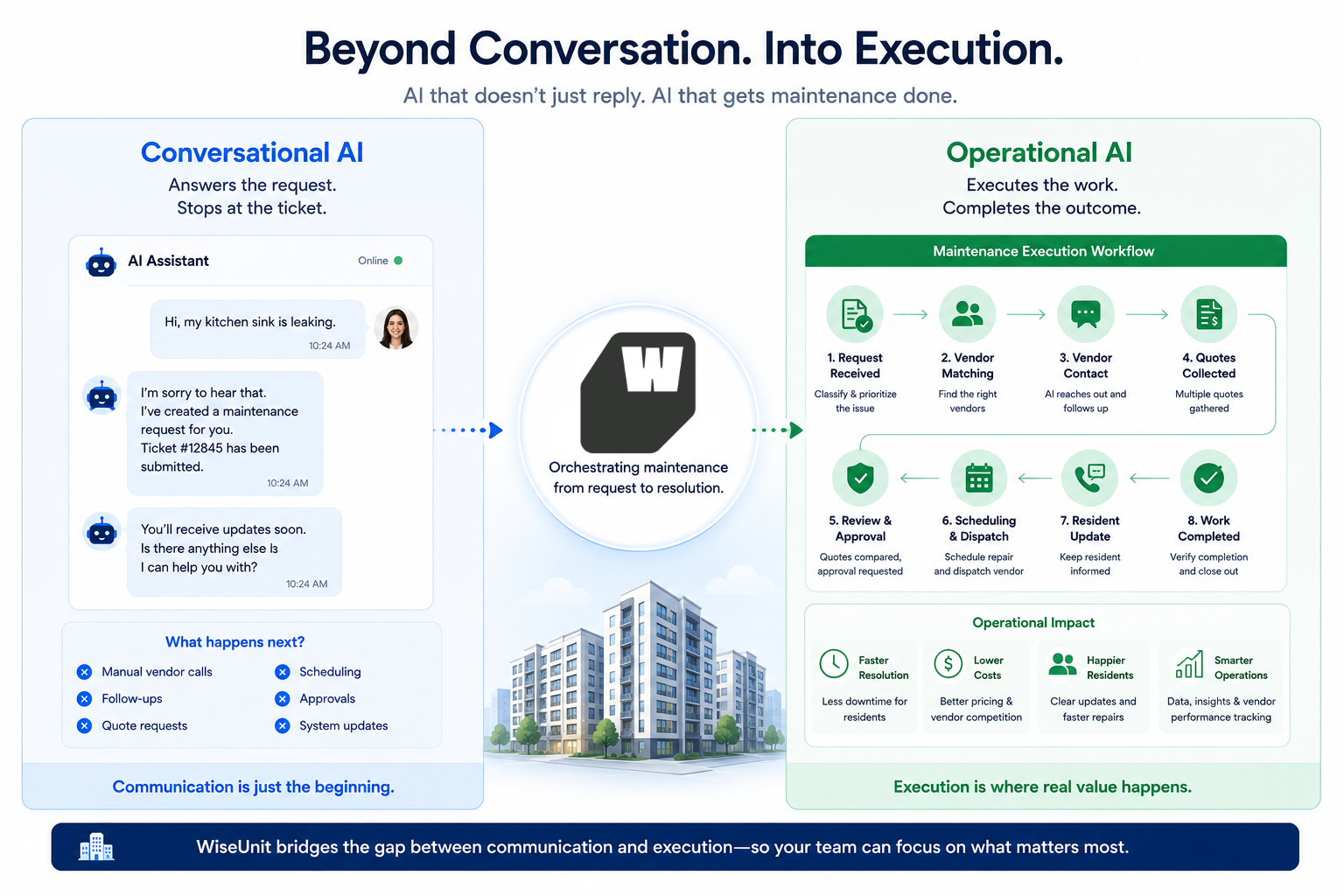
Conversational AI
Resident reports a leaking sink.
↓
AI responds instantly.
↓
Work order created.
↓
Conversation ends.
Operational AI
Resident reports a leaking sink.
↓
AI classifies urgency.
↓
Identifies the required trade.
↓
Finds preferred vendors.
↓
Requests quotes.
↓
Follows up automatically.
↓
Compares pricing.
↓
Checks compliance.
↓
Routes approvals.
↓
Schedules the repair.
↓
Updates the resident.
↓
Updates the PMS.
↓
Tracks vendor performance.
↓
Learns from the completed repair.
Same maintenance request.
Completely different outcome.
Property managers don't buy conversations
Let's ask a simple question.
Why does a property management company invest in AI?
Is it because they want faster conversations?
Partly.
But that isn't the real reason.
They invest in AI because they want:
- - fewer delays
- - happier residents
- - lower maintenance costs
- - less manual coordination
- - more productive teams
- - better vendor performance
None of those outcomes happen simply because a chatbot answered a question.
They happen because maintenance gets executed efficiently.
That is why operational AI matters.
The biggest bottleneck isn't answering the phone
Maintenance coordinators rarely spend their day answering maintenance questions.
Most of their time goes somewhere else.
Calling vendors.
Waiting for replies.
Following up.
Scheduling repairs.
Comparing quotes.
Checking compliance.
Updating work orders.
Updating residents.
Requesting approvals.
Coordinating access.
Those repetitive operational tasks consume far more time than the initial resident conversation.
If AI only solves the conversation...
The operational bottleneck still exists.
Communication is important.
Execution is transformational.
We're not arguing that conversational AI isn't valuable.
It is.
Residents appreciate quick responses.
Property managers benefit from fewer missed calls.
Leasing teams save time.
But communication should be the beginning of automation.
Not the end.
The greatest opportunity for AI is helping maintenance move from request...
...to completion.
That is where the largest operational gains exist.
And that's where WiseUnit is focused.
The future of AI isn't more conversations
The first generation of AI focused on answering questions.
The next generation will focus on completing work.
Think about what businesses actually buy.
They don't buy conversations.
They buy outcomes.
In maintenance, the outcome isn't:
"The resident received a reply."
The outcome is:
"The repair was completed."
That is a fundamental shift in how we think about AI.
And it changes what property management companies should expect from technology.
Communication is only Step 1
One of the biggest reasons AI feels underwhelming in maintenance is because most platforms automate only the first step.
The resident submits a request.
The AI replies.
The ticket is created.
Then...
The maintenance team takes over.
From that point forward, everything becomes manual again.
The emails.
The phone calls.
The follow-ups.
The scheduling.
The approvals.
The vendor coordination.
The quote comparison.
The compliance checks.
The resident updates.
The AI disappears exactly where the most expensive work begins.
Maintenance isn't a conversation
Maintenance is an operational workflow.
Think about the life of a single maintenance request.
It doesn't begin and end with a chat message.
It moves through dozens of operational stages.
Resident submits request.
↓
Issue is classified.
↓
Trade identified.
↓
Vendor selected.
↓
Vendor contacted.
↓
Quote received.
↓
Quote compared.
↓
Approval requested.
↓
Scheduling coordinated.
↓
Repair completed.
↓
Invoice reviewed.
↓
PMS updated.
↓
Vendor performance recorded.
↓
Historical pricing updated.
That's maintenance.
Notice how only one step involves talking to the resident.
Everything else is execution.
The difference between Conversational AI and Operational AI
This is the distinction we believe property management will increasingly make over the next few years.
Conversational AI
Operational AI
Answers questions
Executes work
Creates maintenance tickets
Coordinates vendors
Talks to residents
Dispatches vendors
Summarizes conversations
Collects quotes
Handles phone calls
Compares pricing
Sends updates
Routes approvals
Ends after the conversation
Continues until the repair is complete
Optimizes communication
Optimizes operations
Both have value.
But they solve different problems.
One improves communication.
The other improves execution.
WiseUnit was built for the second category.
Why the biggest operational costs happen after the conversation
Most executives assume resident communication consumes the majority of maintenance effort.
In reality, that's only a small portion.
The largest operational cost comes afterward.
Think about everything required to coordinate one repair:
- - finding the right vendor
- - requesting availability
- - collecting estimates
- - comparing quotes
- - negotiating pricing
- - checking licenses and insurance
- - requesting manager approval
- - scheduling access
- - coordinating with residents
- - updating the PMS
- - following up if the vendor goes silent
- - confirming completion
None of these tasks are particularly difficult.
But together they consume hours.
Now multiply that across hundreds or thousands of maintenance requests each month.
That's where maintenance teams spend their time.
Not answering questions.
Moving work forward.
Why AI works better on the vendor side
Resident conversations are unpredictable.
People are frustrated.
They describe problems differently.
Sometimes they don't know what's broken.
Sometimes they're emotional.
Sometimes they simply want reassurance.
That requires empathy and judgment.
Vendor coordination is different.
It's operational.
The workflow is structured.
A vendor either:
- - accepted the request
- - declined it
- - submitted the quote
- - didn't respond
- - scheduled the repair
- - completed the work
- - uploaded the invoice
These workflows follow repeatable patterns.
That makes vendor operations an ideal place for AI.
Not because vendors are easier.
Because the work is structured.
Structured work is exactly where automation creates the greatest operational leverage.
The Maintenance Execution Gap appears again
In our previous article, we introduced the idea of the Maintenance Execution Gap.
Everything between:
Work Order Created
and
Repair Completed
is execution.
This blog expands that idea.
Most AI products help create the work order.
Very few help execute everything afterward.
That means the Maintenance Execution Gap still exists.
The conversation has improved.
The operation hasn't.
WiseUnit was designed to close that gap.
What happens after WiseUnit receives a maintenance request?
Let's compare two different workflows.
Traditional AI Chatbot
Resident reports leaking sink.
↓
AI responds.
↓
Work order created.
↓
Maintenance coordinator takes over.
↓
Manual vendor communication begins.
WiseUnit Operational AI
Resident reports leaking sink.
↓
AI classifies urgency.
↓
Identifies plumbing trade.
↓
Checks company maintenance policies.
↓
Finds preferred vendors.
↓
Requests quotes automatically when appropriate.
↓
Follows up with vendors.
↓
Compares pricing and historical data.
↓
Verifies vendor compliance.
↓
Routes approval request.
↓
Schedules repair.
↓
Updates resident automatically.
↓
Updates PMS.
↓
Tracks vendor performance.
↓
Stores pricing history.
↓
Learns from the completed repair.
The conversation lasted seconds.
The execution continued until the maintenance request was fully completed.
That's the difference.
Every maintenance request should become smarter
One thing most AI chatbots never do is learn operationally.
They answer today's question.
Tomorrow they answer another one.
WiseUnit treats every maintenance request as a learning opportunity.
Every completed repair strengthens:
- - vendor intelligence
- - pricing intelligence
- - response time benchmarks
- - scheduling accuracy
- - vendor performance history
- - quote fairness
- - historical maintenance costs
- - preferred vendor recommendations
The platform becomes more valuable over time because every completed repair improves future decisions.
That's operational intelligence.
Not conversational intelligence.
Why property managers don't need another chatbot
Most property management companies already communicate well.
Their challenge isn't sending messages.
Their challenge is coordinating thousands of maintenance interactions every month.
Every work order creates dozens of operational decisions.
Those decisions determine:
- - maintenance cost
- - repair speed
- - vendor quality
- - resident satisfaction
- - owner satisfaction
- - team productivity
Improving those decisions creates far greater operational value than simply responding faster to maintenance requests.
That is why we believe Operational AI represents the next chapter of property management technology.
The future of AI isn't conversation
When most people think about AI in property management, they imagine a better chatbot.
A smarter voice assistant.
A faster response.
Better summaries.
Those improvements matter.
But they are only the beginning.
The next generation of AI won't be judged by how well it talks.
It will be judged by how much work it completes.
The companies that gain the biggest operational advantage won't simply answer residents faster.
They'll execute maintenance better.
That is where the industry is heading.
Why WiseUnit chose Operational AI
When we started building WiseUnit, we asked ourselves a simple question.
Where do maintenance teams actually spend their time?
The answer wasn't surprising.
Not answering maintenance calls.
Not creating work orders.
Most of the day was spent coordinating what happened after.
Calling vendors.
Waiting for replies.
Following up.
Collecting quotes.
Comparing pricing.
Checking compliance.
Scheduling.
Updating residents.
Updating the PMS.
Managing exceptions.
That's where maintenance teams lose hours every day.
So instead of building another AI receptionist...
We built an AI maintenance execution platform.
Because that's where we believe the largest operational opportunity exists.
The real KPI isn't response time
Many AI platforms proudly advertise:
- - "Respond in under 30 seconds."
- - "Never miss a phone call."
- - "24/7 availability."
Those are useful metrics.
But they aren't the metrics property managers ultimately care about.
The real questions are:
- - Was the repair completed faster?
- - Did vendor coordination require less manual work?
- - Were maintenance costs controlled?
- - Were quotes compared?
- - Did residents receive updates automatically?
- - Did managers spend less time chasing vendors?
- - Did the team complete more work without increasing administrative overhead?
Those are execution metrics.
And execution metrics are business metrics.
AI should become another member of the operations team
Think about your maintenance team today.
Everyone has a role.
Maintenance Coordinator.
Regional Manager.
Maintenance Supervisor.
Vendor.
Property Manager.
Now imagine another team member.
Not someone answering phones.
Someone whose full-time job is:
- - coordinating vendors
- - requesting quotes
- - sending reminders
- - routing approvals
- - checking compliance
- - updating systems
- - tracking vendor performance
- - learning from every completed repair
That is how we think about WiseUnit.
Not as software.
Not as a chatbot.
As an operational teammate that never stops coordinating maintenance.
The long-term vision
Today, most companies think about AI one conversation at a time.
Tomorrow, they'll think about AI one workflow at a time.
Maintenance.
Turns.
Inspections.
Preventive maintenance.
Vendor management.
Capital projects.
Every operational workflow contains repetitive coordination.
Those are exactly the types of workflows AI can help execute.
We believe maintenance is only the beginning.
Operational AI has the potential to become the execution layer for many operational processes across property management.
Property management doesn't need more conversations
It needs more completed work.
Residents don't measure success by how quickly an AI responded.
They measure success by whether the repair was completed.
Owners don't judge operations by chatbot quality.
They judge operations by maintenance performance.
Property managers don't celebrate fast ticket creation.
They celebrate fast maintenance completion.
That is why execution matters more than conversation.
Why this changes how companies should evaluate AI
If you're evaluating AI vendors, consider asking a different set of questions.
Instead of asking:
- - Can it answer calls?
- - Can it reply to emails?
- - Can it summarize conversations?
Ask:
- - Can it coordinate vendors?
- - Can it reduce manual follow-ups?
- - Can it compare maintenance quotes?
- - Can it improve vendor performance?
- - Can it automate approvals?
- - Can it schedule repairs?
- - Can it keep maintenance moving without constant human intervention?
- - Can it help my existing team manage more work?
Those questions focus on operational outcomes.
And operational outcomes are what create long-term value.
Conversation starts the workflow.
Execution finishes it.
We don't believe conversational AI is the problem.
In fact, it's an important part of the maintenance experience.
Residents deserve fast responses.
Managers deserve fewer interruptions.
Leasing teams deserve better communication tools.
But the biggest operational gains don't come from ending the conversation faster.
They come from executing the work more efficiently afterward.
Conversation starts the workflow.
Execution finishes it.
That is the difference between Conversational AI and Operational AI.
And that's the difference WiseUnit was built around.
Final thoughts
The property management industry doesn't have a communication problem.
It has an execution problem.
Most maintenance requests don't become expensive because someone forgot to answer the phone.
They become expensive because vendor coordination, approvals, scheduling, and follow-ups consume enormous amounts of time.
We believe AI should solve that problem.
Not simply by talking.
By working.
That's why WiseUnit isn't focused on replacing your front desk.
It's focused on helping your operations team execute maintenance from request to completion.
Because at the end of the day...
Residents don't remember the chatbot.
They remember whether their maintenance issue was actually fixed.
Ready to see Operational AI in action?
WiseUnit helps property management companies move beyond AI chatbots by automating vendor coordination, intelligent dispatch, multi-bidding, quote comparison, scheduling, compliance tracking, approvals, PMS synchronization, vendor intelligence, and maintenance pricing intelligence.
If you're curious what Operational AI could look like inside your maintenance operation, we'd love to show you.
Book a WiseUnit demo and see how AI can do more than answer maintenance requests—it can help execute them.
Frequently Asked Questions
- What is Operational AI in property management?
- Operational AI focuses on executing business workflows rather than only communicating with users. In property management maintenance, this includes vendor coordination, dispatch, quote collection, scheduling, approvals, compliance, and workflow automation.
- What is the difference between Conversational AI and Operational AI?
- Conversational AI is designed to answer questions, respond to residents, and create work orders. Operational AI continues after the conversation by coordinating the maintenance workflow until the repair is completed.
- Are AI chatbots still useful?
- Absolutely. AI chatbots improve resident communication, reduce missed calls, and provide instant responses. However, they typically address only one part of the maintenance process. Operational AI focuses on executing the work that follows.
- Does WiseUnit replace maintenance coordinators?
- No. WiseUnit supports maintenance teams by reducing repetitive coordination work while keeping managers in control of vendor relationships, approvals, and operational decisions.
- Why does WiseUnit focus on vendors instead of only residents?
- Most of the operational effort in maintenance occurs after the resident submits a request. Vendor coordination, scheduling, approvals, compliance, and follow-ups consume significantly more time than the initial conversation. WiseUnit focuses on automating that operational workload.