Why maintenance coordination stops scaling
Every growing property management company eventually faces the same challenge.
Maintenance becomes harder to manage. Not because repairs become more complicated. Because coordination does.
At first, one maintenance coordinator can handle everything. They know every vendor. They know which plumber to call. They remember which HVAC company responds the fastest. They know which electrician usually gives the best prices.
But as portfolios grow, memory stops scaling.
One property becomes twenty. Twenty becomes two hundred. Two hundred becomes thousands of units.
Suddenly maintenance isn't just about fixing problems. It's about coordinating thousands of small operational decisions every month.
That's where an AI Coordinator comes in. Not to replace your maintenance team. To help your maintenance team execute more work with less manual coordination.
Maintenance coordinators don't fix maintenance
Ask most maintenance coordinators what they spend their day doing. The answer usually isn't: "Repairing properties."
Instead, their days are filled with coordination:
- - Calling vendors
- - Following up on quotes
- - Checking who responded
- - Scheduling repairs
- - Requesting approvals
- - Updating the PMS
- - Sending resident updates
- - Checking insurance
- - Finding another vendor when someone declines the job
- - Moving work from one stage to the next
They're coordinating maintenance, not performing the repair itself. And that's exactly why the role is becoming harder every year.
The real job is moving work forward
Think about one maintenance request. A resident reports a leaking water heater. The repair itself may take one hour. Getting to that repair can take days.
Someone has to:
- - identify the correct trade
- - determine urgency
- - contact vendors
- - compare availability
- - request estimates
- - follow up with vendors
- - review pricing
- - verify compliance
- - request manager approval
- - coordinate scheduling
- - update the resident
- - update the PMS
- - confirm completion
Every one of those steps requires coordination. Individually, they don't seem like much. Together, they become the largest operational workload inside maintenance.
The coordination problem grows faster than the portfolio
Managing 300 units feels very different from managing 3,000.
At smaller portfolios, people rely on experience: "We've always used this vendor." "I'll remember to call them later." "I know who usually handles this."
As companies grow, those informal processes begin to break down. Maintenance requests increase. Vendor relationships increase. Approvals increase. Scheduling becomes more complex.
Every additional property creates more coordination. Eventually the workload grows faster than the team.
The challenge isn't finding good people. It's giving good people a system that scales.
The maintenance coordinator is becoming one of the busiest roles in property management
Property management has become more demanding. Residents expect faster responses. Owners expect more transparency. Vendors work across larger service areas. Compliance requirements continue to increase. Maintenance costs continue to rise.
None of these trends reduce the coordinator's workload. Most of them increase it.
That means maintenance coordinators often spend their day reacting instead of improving operations. They chase updates, respond to delays, follow up with vendors, handle scheduling conflicts, update systems, and repeat.
The result is constant activity, but not always better execution.
AI isn't replacing coordinators
One of the biggest misconceptions about AI is that it's designed to replace people. We see it differently.
The best AI removes repetitive work. It doesn't remove operational judgment.
Some maintenance tasks require experience and should remain with people:
- - Choosing between two vendors
- - Approving a large repair
- - Handling a difficult resident
- - Managing an emergency
Other tasks are repetitive:
- - Following up with vendors
- - Sending reminders
- - Requesting quotes
- - Updating systems
- - Scheduling appointments
- - Checking documentation
Those are exactly the kinds of operational tasks AI can help coordinate.
The goal isn't fewer maintenance professionals. The goal is allowing maintenance professionals to spend more time managing maintenance instead of managing administration.
Imagine hiring another coordinator
Imagine your company hires another maintenance coordinator. What would you expect them to do?
- - contact vendors
- - collect quotes
- - follow up
- - schedule repairs
- - update residents
- - request approvals
- - check compliance
- - keep work moving
Now imagine another coordinator joining the team. One that works continuously. Never forgets to follow up. Never forgets to send reminders. Never forgets to update the PMS. Never loses track of a vendor response. Never forgets to request another quote.
That's a useful way to think about an AI Coordinator. Not as software. As another operational teammate.
The AI Coordinator becomes the operational glue
Maintenance doesn't fail because people don't care. It fails because dozens of small operational tasks get delayed.
A vendor forgets to respond. An approval sits in someone's inbox. Scheduling gets postponed. A resident doesn't receive an update. One delay becomes another. Soon a simple repair takes much longer than expected.
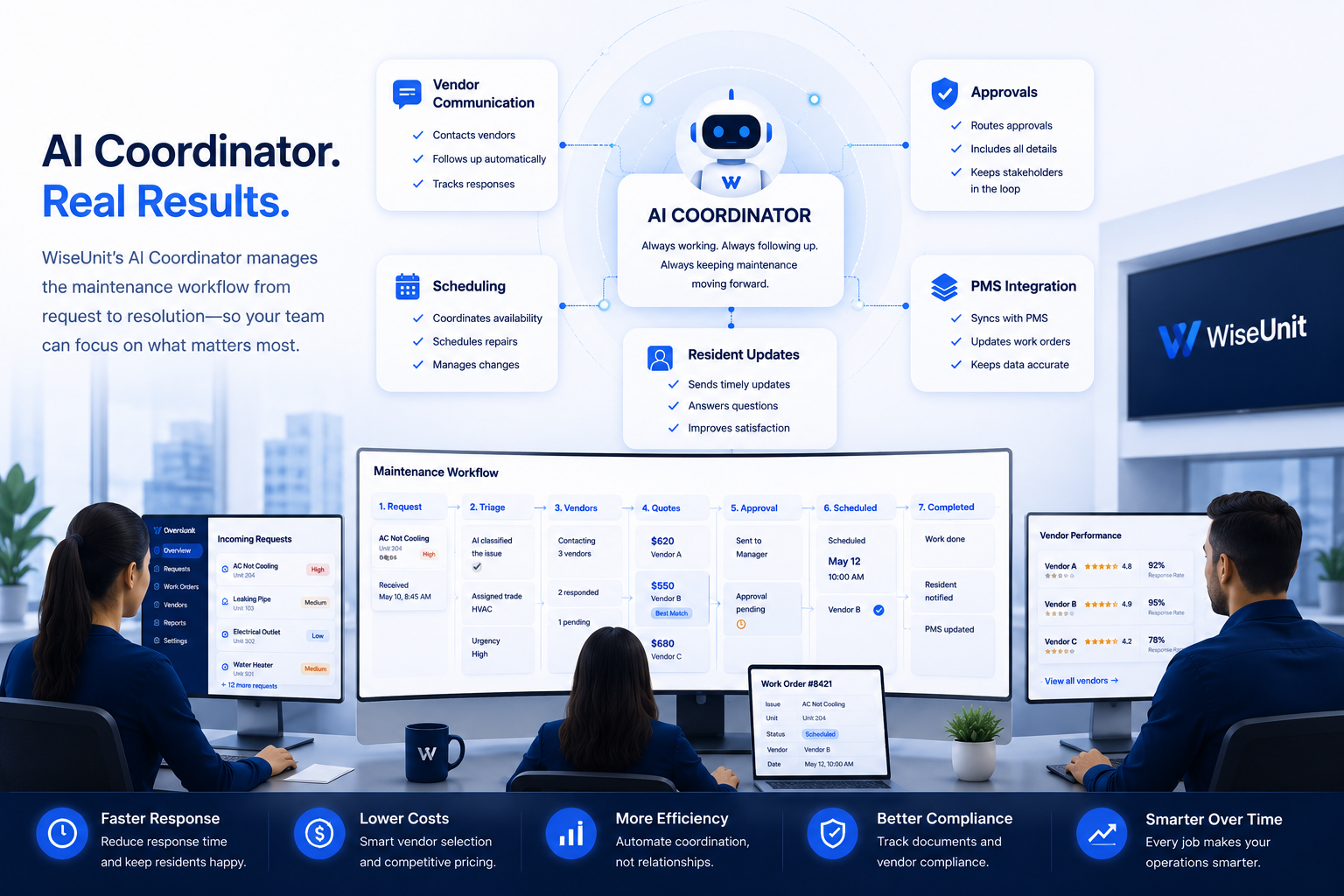
An AI Coordinator helps connect those moving pieces. It keeps the workflow moving. It follows up. Routes approvals. Tracks progress. Updates systems. Coordinates vendors.
The maintenance team remains in control. The AI simply helps ensure nothing falls through the cracks.
Every maintenance team already has an invisible workload
Most maintenance KPIs focus on repairs: completed work orders, average repair time, maintenance spend, and emergency requests.
But very little attention is given to the invisible work surrounding every repair:
- - The emails
- - The phone calls
- - The reminders
- - The approvals
- - The scheduling changes
- - The vendor follow-ups
- - The status updates
- - The documentation
This operational workload rarely appears on reports. Yet it's where maintenance coordinators spend much of their day.
That invisible workload is exactly where an AI Coordinator creates value.
The future maintenance team
We believe future maintenance teams won't simply consist of maintenance managers, maintenance coordinators, property managers, and vendors.
There will be another member of the team: the AI Coordinator.
Not replacing anyone. Helping everyone. Taking responsibility for repetitive operational coordination while allowing experienced professionals to focus on judgment, relationships, and complex decision-making.
That's a very different vision from an AI chatbot. It's Operational AI. And it's changing how maintenance gets executed.
What does an AI Coordinator actually do?
One of the first questions we hear is: "What exactly would an AI Coordinator do on my team?"
The simplest answer is this: an AI Coordinator handles the repetitive operational work that keeps maintenance moving.
Think of it as another maintenance coordinator. Except instead of manually sending emails, making calls, following up, updating systems, and tracking every repair, it helps coordinate those workflows automatically.
The goal isn't to make maintenance decisions. The goal is to make sure the maintenance process never stops moving.
A day in the life of an AI Coordinator
Imagine it's Monday morning. Over the weekend, 47 maintenance requests came in. Some are emergencies. Some are routine. Some need owner approval. Some require multiple vendor quotes.
Instead of your maintenance team manually sorting every request, the AI Coordinator immediately begins working. It can:
- - classify urgency
- - identify the required trade
- - route work according to company rules
- - identify preferred vendors
- - determine whether multiple quotes are needed
- - prepare approval requests
- - begin vendor communication
- - keep the workflow moving
Before your team has finished their morning coffee, maintenance execution has already started.
The AI Coordinator checklist
Think about everything a maintenance coordinator does throughout the day. Now imagine having another teammate helping with those responsibilities.
Vendor coordination
- - Contacts vendors
- - Sends job details
- - Requests availability
- - Follows up automatically
Quote management
- - Requests estimates
- - Collects multiple quotes
- - Organizes pricing
- - Highlights quote differences
Vendor intelligence
- - Reviews historical vendor performance
- - Tracks response times
- - Identifies reliable vendors
- - Maintains pricing history
Compliance
- - Checks insurance status
- - Reviews vendor documentation
- - Flags missing compliance requirements
Approval workflows
- - Routes approvals
- - Provides quote comparisons
- - Includes supporting information
- - Keeps managers informed
Scheduling
- - Coordinates vendor availability
- - Helps schedule repairs
- - Tracks appointment changes
- - Keeps workflows progressing
Communication
Instead of replacing the coordinator, the AI Coordinator becomes another operational resource working alongside the team.
- - Updates residents
- - Keeps vendors informed
- - Records maintenance progress
- - Synchronizes with the PMS
AI doesn't make the decisions
This is an important distinction. Many people assume AI means giving up control. That's not how WiseUnit works.
Property managers still define:
- - preferred vendors
- - approval thresholds
- - spending limits
- - emergency policies
- - escalation rules
- - owner approval requirements
- - maintenance workflows
WiseUnit follows those operational rules. It doesn't invent them.
Think of the AI Coordinator like a highly organized operations assistant. It keeps the workflow moving. Managers remain responsible for operational judgment.
A traditional maintenance coordinator vs. an AI Coordinator
Let's compare the two:
- - Calls vendors → Contacts vendors automatically
- - Sends reminder emails → Follows up automatically
- - Collects quotes → Organizes and tracks quotes
- - Checks vendor documents → Flags compliance issues
- - Updates spreadsheets → Synchronizes with PMS
- - Tracks maintenance manually → Monitors workflows continuously
- - Coordinates one request at a time → Helps coordinate many requests simultaneously
Notice something important. These aren't competing roles. They're complementary.
The AI Coordinator handles repetitive operational tasks. The human coordinator focuses on relationships, judgment, and problem-solving. Together, they become a stronger maintenance team.
The maintenance execution checklist
Let's follow a real maintenance request. A resident reports: "My air conditioner stopped working." Here's how the workflow might look.
Traditional workflow
- - Resident submits request
- - Maintenance coordinator reads ticket
- - Looks for HVAC vendor
- - Calls vendor
- - Leaves voicemail
- - Waits for callback
- - Calls another vendor
- - Requests estimate
- - Waits again
- - Compares quotes
- - Emails manager
- - Manager approves
- - Coordinator schedules repair
- - Updates resident
- - Updates PMS
Every step depends on someone remembering the next task.
AI Coordinator workflow
- - Resident submits request
- - AI identifies HVAC issue
- - Classifies urgency
- - Checks company policies
- - Contacts preferred vendors
- - Requests quotes when appropriate
- - Follows up automatically
- - Organizes pricing
- - Highlights historical vendor performance
- - Checks compliance
- - Routes approval request
- - Coordinates scheduling
- - Updates resident
- - Updates PMS
- - Records vendor performance
- - Updates maintenance pricing intelligence
The maintenance manager stays involved. The repetitive coordination doesn't have to remain manual.
Why AI Coordinators become more valuable as portfolios grow
Managing 500 units is different from managing 5,000. At larger portfolios there are more vendors, repairs, scheduling, approvals, follow-ups, and communication.
The maintenance process doesn't become harder because repairs are more complicated. It becomes harder because there are more moving pieces.
That's exactly where an AI Coordinator creates value. It helps coordinate increasing operational complexity without requiring every repetitive task to be handled manually.
The hidden benefit: consistency
People naturally work differently. One coordinator follows up every two hours. Another waits until tomorrow. One always requests three quotes. Another usually requests one. One updates the PMS immediately. Another updates it at the end of the day.
None of these people are wrong. They're simply different.
An AI Coordinator introduces consistency. Every workflow follows company policies. Every approval follows the correct process. Every vendor receives the right information. Every maintenance request follows the same operational standards.
That consistency becomes increasingly valuable as companies grow across multiple offices, teams, and regions.
The AI Coordinator never stops learning
One of the biggest advantages of Operational AI is continuous improvement. Every completed repair helps improve future maintenance execution.
Over time, the AI Coordinator develops a deeper understanding of:
- - vendor response times
- - pricing trends
- - repair history
- - seasonal demand
- - scheduling performance
- - quote fairness
- - vendor reliability
- - compliance history
The result isn't just automation. It's operational intelligence. Every maintenance request helps make the next one smarter.
The AI Coordinator isn't another software subscription
This is where we believe the industry is changing. Most software gives your team another dashboard. Another login. Another workflow to manage.
An AI Coordinator should feel different. It shouldn't feel like another application. It should feel like another member of the operations team.
One that helps coordinate maintenance every day. One that never forgets to follow up. One that keeps work moving. One that allows your existing team to focus on solving problems instead of chasing them.
That's the role we believe AI will increasingly play in property management maintenance.
The future maintenance team
Property management has changed dramatically over the last decade. Accounting became digital. Leasing became digital. Inspections became digital. Maintenance workflows moved into Property Management Systems.
The next evolution isn't another dashboard. It's operational execution.
We believe future maintenance teams will include both people and AI working together. Not because people can't do the work. Because the volume of coordination keeps growing.
The best maintenance teams won't replace coordinators. They'll give them better operational support.
From software to teammates
For years, software has followed the same model: log in, check your dashboard, complete your tasks, repeat.
AI changes that model. Instead of asking people to manage software, software begins helping people manage work. That's a fundamental shift.
An AI Coordinator doesn't wait for someone to click a button. It helps keep maintenance moving. It follows up. Coordinates vendors. Tracks approvals. Updates systems. Supports the team throughout the entire maintenance lifecycle.
The software becomes an active participant in operations.
AI should make your team feel bigger
Hiring experienced maintenance coordinators isn't easy. As portfolios grow, many companies face the same question: "Do we hire another coordinator?"
Sometimes the answer is yes. Sometimes the existing team simply needs better operational support.
An AI Coordinator helps experienced coordinators handle more work without increasing administrative overhead. It doesn't replace relationships. It doesn't replace judgment. It removes repetitive coordination so people can spend more time solving problems.
Better coordination creates better maintenance
Residents don't see your internal workflows. They don't know how many phone calls were made. They don't know how many vendors declined the job. They don't know how many approvals happened behind the scenes.
They only experience the result. Was someone responsive? Was the repair scheduled quickly? Did they receive updates? Was the issue resolved?
Good maintenance isn't just about finding a good vendor. It's about coordinating every step between the maintenance request and the completed repair.
That's where operational excellence is created.
The AI Coordinator fits into your existing workflow
One common misconception is that adding AI means replacing existing systems. It doesn't.
Property Management Systems remain the system of record. They continue storing:
- - residents
- - units
- - vendors
- - properties
- - leases
- - work orders
- - accounting records
The AI Coordinator works alongside those systems. It helps execute the maintenance process using the operational rules your team already follows.
Instead of replacing your existing technology, it helps your existing technology deliver better outcomes.
Coordination becomes intelligence
Every maintenance request creates valuable information. How quickly did the vendor respond? Was the quote reasonable? Was the repair completed on time? Did the resident report the same issue again? How long did approval take? Which vendors consistently perform well?
Most organizations store this information. Very few actually learn from it.
An AI Coordinator should improve over time. Each completed maintenance request helps future maintenance decisions become faster, more informed, and more consistent.
Execution creates intelligence. Intelligence improves execution. That's the flywheel.
The next competitive advantage
Property management has spent years investing in visibility: dashboards, reports, KPIs, and analytics.
Knowing what's happening is important. But visibility alone doesn't complete maintenance. Execution does.
The companies that outperform over the next decade won't simply have more data. They'll execute faster, coordinate better, and continuously learn from every maintenance request.
That's where Operational AI has the greatest opportunity.
Final thoughts
Maintenance has never been just about fixing properties. It's about coordinating people. Coordinating vendors. Coordinating approvals. Coordinating schedules. Coordinating communication.
As portfolios continue to grow, that coordination becomes more complex.
We believe every maintenance team will eventually have another member. Not another administrator. Not another dashboard. An AI Coordinator.
One that helps maintenance teams spend less time chasing work and more time completing it.
Because maintenance isn't remembered by how many emails were sent. It's remembered by how efficiently problems were solved.
Frequently Asked Questions
- What is an AI Coordinator?
- An AI Coordinator is an AI-powered operational assistant that helps maintenance teams coordinate repetitive workflows such as vendor communication, scheduling, quote collection, approvals, resident updates, and PMS synchronization.
- Does an AI Coordinator replace maintenance coordinators?
- No. An AI Coordinator is designed to support maintenance professionals by handling repetitive operational tasks while people continue making business decisions and managing relationships.
- Can AI coordinate vendors?
- Yes. AI can help contact vendors, request quotes, follow up, organize responses, assist with scheduling, and keep maintenance workflows moving according to company rules.
- Does an AI Coordinator replace Property Management Software?
- No. Property Management Systems remain the system of record. An AI Coordinator acts as the system of execution, helping maintenance workflows progress efficiently using the data already stored in the PMS.
- What are the benefits of using an AI Coordinator?
- Organizations can benefit from less manual coordination, faster vendor communication, more consistent maintenance workflows, better visibility into maintenance operations, improved vendor intelligence, and a reduced administrative workload for maintenance teams.