
The Maintenance Execution Gap: Why Property Managers Need More Than a Work Order System
A practical guide to the maintenance execution gap and how property management teams can move from tracking maintenance to actually completing it.
What Is the Maintenance Execution Gap?
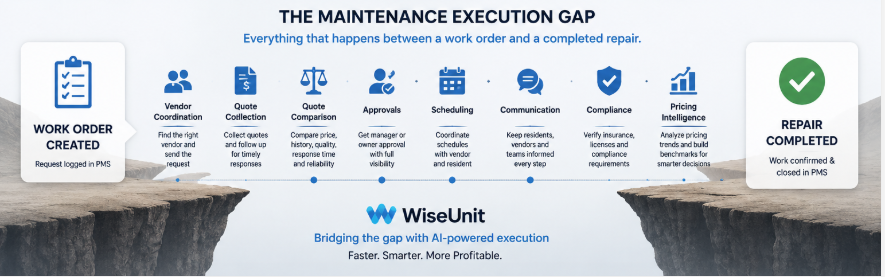
The maintenance execution gap is the space between creating a maintenance work order and actually completing the repair.
Most teams already have software that logs the request. The gap appears after intake, when someone still has to choose the right vendor, chase quotes, compare pricing, secure approval, schedule the visit, update the resident, check compliance, and close the loop in the PMS.
In other words, the work order says work needs to happen. Execution is what makes it happen.
Why Maintenance Does Not Fail Because of Work Orders
Property management companies do not usually fail because they are missing a place to store maintenance requests.
They fail because the workflow after the request is still manual, fragmented, and dependent on people remembering the next step.
The issue is not visibility. It is follow-through.
For the broader operating model, read our Maintenance Execution Software guide.
Visibility Is Not Execution
Most PMS platforms do a good job of showing what is open, what is complete, and which unit or resident is affected.
That visibility matters, but it does not move the maintenance ticket forward by itself.
A work order can be open in the system while the vendor has not replied, the approval is still pending, the resident is waiting for an update, and the repair is sitting in limbo.
- Open work order status does not mean a vendor has responded.
- A resident portal does not automatically schedule the repair.
- A completed note does not always mean the invoice or compliance record is closed out.
The Difference Between Management Software and Execution Software
Property management software is designed to manage information.
Maintenance execution software is designed to move work.
Those are related, but they are not the same thing.
- PMS: residents, leases, units, accounting, owners, vendors, and work orders
- Execution software: vendor coordination, dispatch, scheduling, approvals, follow-ups, and completion
- PMS: system of record
- Execution software: system of action
Why Maintenance Slows Down After the Work Order Is Created
The slow part of maintenance is rarely creating the request.
The slow part is everything that follows: calling vendors, waiting for replies, sending reminders, collecting quotes, comparing pricing, checking compliance, requesting approval, coordinating access, updating residents, and copying notes back into the PMS.
Each task is small on its own. Together, they create the execution gap.
Why Adding More People Is Not Always the Answer
Hiring another coordinator can help, but it does not solve a broken workflow.
If the process is still manual, every new hire is simply pushed into the same coordination work: vendor follow-up, quote requests, approval chasing, scheduling, and resident updates.
Execution software creates leverage by removing repetitive admin work instead of just adding more hands to the same queue.
- More headcount often scales cost linearly.
- Automation scales coordination more efficiently.
- The best teams spend more time on judgment and less time on admin.
Why AI Works Better on the Vendor Side
Tenant-facing AI can be risky if it is used carelessly because residents are emotional and maintenance issues are often urgent.
Vendor coordination is different. It is structured operational work: accepted, declined, quoted, scheduled, completed, or missing a response.
That makes the vendor side a strong place to use AI for follow-ups, dispatch, and coordination.
- AI can follow up without waiting for someone to remember.
- AI can compare response patterns and vendor reliability.
- AI can keep maintenance moving while humans handle exceptions and approvals.
The 9-Step Maintenance Execution Framework
A maintenance request moves through a predictable workflow whether teams formalize it or not.
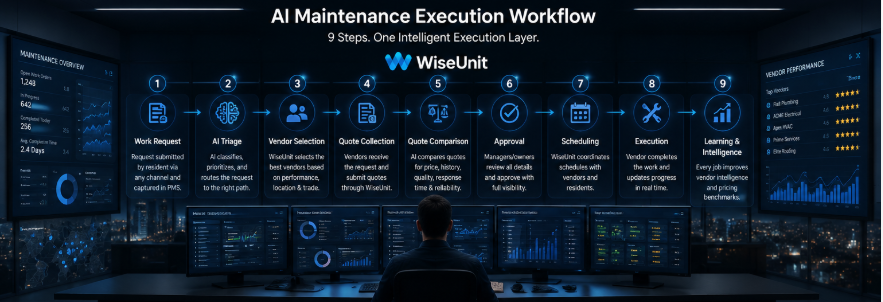
WiseUnit organizes that workflow into nine steps so the work keeps moving from request to completion.
- 1. Work request
- 2. Intelligent triage
- 3. Vendor selection
- 4. Quote collection
- 5. Quote comparison
- 6. Approval
- 7. Scheduling
- 8. Execution
- 9. Learning
Step 1 Through Step 3: Request, Triage, Vendor Selection
The first stage is simply receiving the request.
The next stage is triage: is it urgent, what trade is needed, does it require approval, and should a preferred vendor be dispatched?
Then comes vendor selection, where historical performance, location, pricing, and compliance all matter.
For a deeper look at this operating layer, see our WiseUnit maintenance execution layer article.
Step 4 Through Step 6: Quote Collection, Comparison, and Approval
Many repairs require estimates before work can move forward.
That means quote collection, quote follow-up, pricing comparison, and approval routing all become part of the maintenance workflow.
Execution software should not just gather the quote. It should keep the approval process moving with the right context attached.
- Quote collection and reminders
- Historical price comparison
- Vendor reliability context
- Approval routing with the right documentation
Step 7 Through Step 9: Scheduling, Execution, and Learning
Scheduling becomes complex as soon as the resident, vendor, and property team all have to align.
Once the repair is underway, the execution layer should keep stakeholders updated until the job is complete.
The final step is learning: every completed repair should make the next one smarter through vendor performance history, pricing intelligence, and completion data.
- Scheduling coordination
- Resident and vendor updates
- Completion confirmation
- Vendor intelligence
- Pricing intelligence
Most PMS Platforms Stop at Visibility
Traditional software is excellent at answering questions like what work orders are open, which property is affected, and what the current status is.
Those are useful questions, but they are not the whole maintenance problem.
Execution software asks a different set of questions: why has the vendor not responded, should another quote be requested, is the price reasonable, who should approve it, and what needs to happen next?
The Cost of Waiting
Maintenance delays create ripple effects that are bigger than the repair invoice.
One delayed request can create multiple resident calls, frustrated owners, rescheduling, overtime, lower satisfaction, and a longer work order cycle.
Those costs are easy to miss because they do not always show up in a vendor bill, but they still affect the bottom line.
- More staff time spent following up
- More resident frustration
- More rescheduling and overtime
- More operational drag across the portfolio
The Real Bottleneck Is Coordination
Many executives think they need more vendors, more coordinators, or more maintenance staff.
Sometimes they do. But often the bigger bottleneck is coordination itself.
A few minutes here and there on emails, phone calls, reminders, and approval checks add up to hours of hidden work across every request.
ROI: Why Execution Matters
Two property management companies can manage the same portfolio and still have very different operating costs.
The difference is often what happens after the work order is created.
One team handles everything manually. The other uses an execution layer to automate follow-up, scheduling, resident communication, and vendor performance tracking.
- Faster maintenance completion
- Less manual follow-up
- Better vendor accountability
- Cleaner PMS updates
- More leverage as the portfolio grows
Why Execution Scales Better Than Hiring
As a portfolio grows, maintenance volume, vendor communication, scheduling, and approvals all grow with it.
Hiring more people can help, but it tends to scale cost faster than it scales efficiency.
Execution software scales differently because it automates the movement of information instead of adding more people to move it by hand.
Vendor Intelligence and Pricing Intelligence
Every completed repair should improve the next one.
That is where vendor intelligence and pricing intelligence matter.
When the system learns response times, completion quality, quote accuracy, compliance status, and historical pricing, managers can make better decisions with less guesswork.
- Vendor response history
- Completion performance
- Quote accuracy
- Pricing benchmarks
- Compliance tracking
The Future of Property Management Is Execution
Property management technology has spent years digitizing work.
The next step is making the workflow actually move.
The companies that lead will not just have more software. They will have better operations, faster repair cycles, and a system that turns maintenance into an execution problem instead of a tracking problem.
Closing the Maintenance Execution Gap
The maintenance execution gap exists because too much of the workflow still depends on manual coordination.
WiseUnit was built to close that gap by helping property managers execute maintenance from beginning to end.
That includes triage, vendor selection, dispatch, multi-bidding, quote comparison, compliance tracking, approvals, scheduling, communication, PMS updates, vendor intelligence, and pricing intelligence.
If you want a more detailed walkthrough of the execution model, read our Maintenance Execution Software guide.
For the vendor coordination side of the workflow, see our Vendor Management guide.
Why This Matters as Your Portfolio Grows
A small portfolio can sometimes rely on memory and manual follow-up.
At larger scale, that stops working.
Execution has to become systematic so the team can manage more maintenance volume without increasing coordination overhead at the same pace.
Final Answer: Property Managers Do Not Need Another Dashboard
Most teams already have enough dashboards, reports, and notifications.
What they need is fewer manual tasks and more execution.
That is the core idea behind the maintenance execution gap: if work is not moving, the system is only tracking it, not solving it.
Frequently asked questions
What is the maintenance execution gap?
The maintenance execution gap is everything that happens between creating a work order and completing the repair. It includes vendor coordination, quote collection, approvals, scheduling, follow-up, compliance checks, resident communication, and closeout.
How is maintenance execution software different from property management software?
Property management software manages records and visibility. Maintenance execution software helps move the work forward by automating coordination, follow-up, and completion steps after the work order is created.
Does WiseUnit replace my PMS?
No. WiseUnit works with existing property management systems. Your PMS remains the system of record, while WiseUnit acts as the system of execution.
Why is vendor coordination such a big part of the maintenance execution gap?
Because vendor follow-up, scheduling, pricing, and compliance checks are often the steps that slow maintenance down the most. Those tasks are repetitive enough to automate, but important enough to keep under human oversight.
How does execution software help reduce maintenance backlog?
Execution software helps reduce backlog by keeping requests moving through triage, dispatch, scheduling, approvals, and completion instead of letting work sit between steps.
What should property managers look for in maintenance execution software?
Property managers should look for triage, vendor coordination, quote collection, scheduling, approval routing, resident communication, PMS sync, reporting, and vendor intelligence.