Software Has Changed Property Management
Most companies today use platforms to manage accounting, leasing, maintenance, residents, inspections, communication, and reporting. But there is one problem: most property managers are paying for software whether it delivers value or not.
Every month brings another subscription, user license, implementation, or platform promising efficiency. Eventually, many operators ask the same question: Why am I paying before I receive any value?
That question is changing the way AI companies think about pricing. Instead of charging customers simply for access to software, a growing number of AI businesses are beginning to charge for completed work. This model is often called pay-per-outcome.
At WiseUnit, we believe this is one of the biggest shifts coming to property management technology. Property managers do not need another dashboard. They need maintenance work to get done.
The SaaS Pricing Problem
Traditional SaaS pricing is simple: you pay every month, whether the software creates value or not. These models have worked well for decades, but AI changes something fundamental.
AI does not just organize information. It performs work. That creates a different question: if AI is doing operational work, why should customers pay simply for logging in? Maybe they should pay when the work is actually completed.
- - Per user
- - Per property
- - Per unit
- - Per work order
- - Monthly subscription
- - Annual contract
What Is Pay-Per-Outcome Pricing?
Pay-per-outcome is exactly what it sounds like. Instead of paying for software access, customers pay when a defined business outcome is successfully delivered.
Instead of charging for seats, WiseUnit charges for execution. That creates a different relationship between the software company and the customer. Success becomes shared.
- - A maintenance request successfully coordinated
- - Vendor communication completed
- - Multiple quotes collected
- - A vendor dispatched
- - A repair scheduled
- - A maintenance workflow completed according to company rules
Why Property Managers Are Tired of Buying More Software
Ask almost any property management executive about software and the answer is usually similar: We already have too many systems.
Every platform adds another monthly bill, login, implementation, and training session. The software itself is not necessarily the problem. The problem is paying before operational value has been created.
Property managers do not wake up wanting more software. They wake up wanting fewer maintenance problems.
- - A property management system
- - Accounting and leasing tools
- - Inspection and resident communication software
- - CRM and reporting platforms
- - Scheduling and document management tools
- - Vendor portals
AI Changes How Software Creates Value
Traditional software mostly stores information. AI increasingly performs work. Traditional software helps you create a work order; AI can help execute the steps that follow.
That is not simply software. That is execution, and execution naturally lends itself to outcome-based pricing.
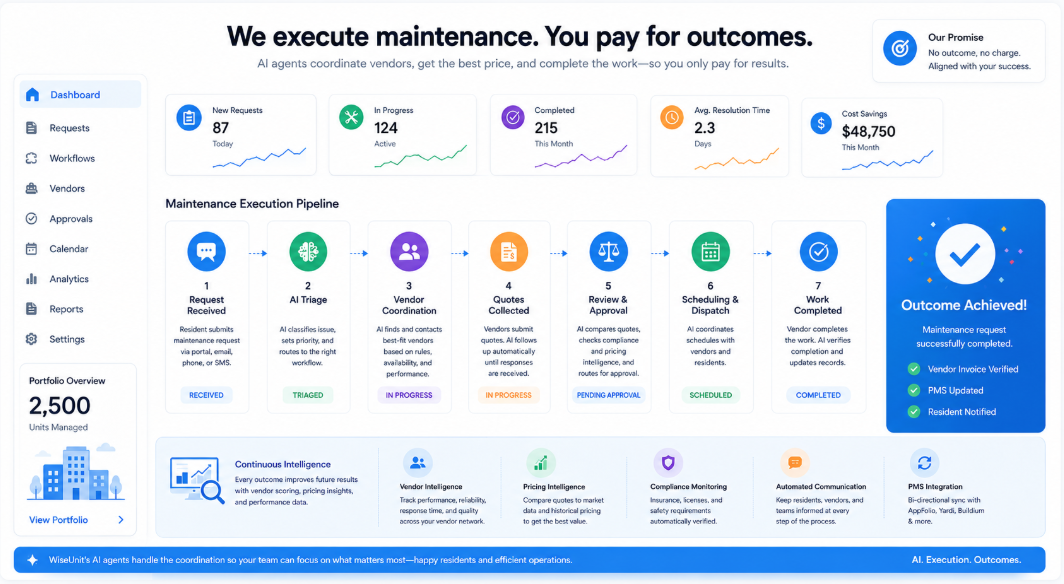
See how this shift closes the maintenance execution gap.
- - Classify the repair and check compliance
- - Contact vendors and request bids
- - Follow up automatically and compare quotes
- - Request approval and schedule the repair
- - Update the PMS and notify residents
Why Incentives Matter
One of the biggest advantages of pay-per-outcome pricing is incentive alignment. With traditional SaaS, the software company gets paid whether customers use the platform heavily or not, adoption succeeds or not, and maintenance improves or not.
Pay-per-outcome changes those incentives. Both sides benefit when work gets completed. Property managers want maintenance executed efficiently, and WiseUnit wants maintenance executed efficiently. Those incentives finally point in the same direction.
That creates a healthier partnership.
The Shift from Software to Digital Labor
Industry analysts increasingly describe AI as digital labor rather than traditional software. The difference matters: software gives people tools, while digital labor performs tasks.
Imagine hiring another maintenance coordinator. You would not pay simply because they showed up; you would expect work to be completed. The same mindset is beginning to apply to AI.
Property managers are becoming less interested in buying software and more interested in buying completed work. That is one reason outcome-based pricing is gaining attention across AI companies.
Why Maintenance Is a Perfect Fit
Not every business can use pay-per-outcome pricing because some work is difficult to measure. Maintenance is different. It naturally creates measurable operational milestones.
These are tangible outcomes, and they create a natural way to measure value. That makes maintenance one of the strongest operational areas for outcome-based AI.
- - Vendor contacted
- - Quote received
- - Approval completed
- - Repair scheduled
- - Repair completed
- - Work order closed
Why This Reduces Customer Risk
Buying software always involves uncertainty. Will the team adopt it? Will implementation succeed? Will employees actually use it? Will it save time and create ROI?
Pay-per-outcome reduces some of that uncertainty. Instead of paying primarily for potential value, customers pay as value is delivered.
That changes the purchasing conversation. Instead of asking whether they want another software subscription, property managers can ask whether they are comfortable paying when the platform successfully handles maintenance work.
The Maintenance Industry Is Changing
Property management has already experienced several technology shifts. Paper files became cloud software, phone calls became resident portals, and manual accounting became digital accounting.
AI represents another shift, but it is not simply another application. It changes who performs the work. Instead of only helping employees do everything manually, AI increasingly becomes another operational resource.
Pricing models should evolve too. Companies that embrace AI as execution rather than software will likely think differently about how customers pay for that execution.
Why WiseUnit Chose This Model
At WiseUnit, we asked ourselves a simple question: if our goal is to reduce vendor coordination work, why should customers pay simply because they have access?
We believe pricing should reflect operational value. If WiseUnit helps coordinate maintenance work, collect vendor quotes, schedule repairs, update systems, and move work toward completion, our success should depend on helping customers achieve those outcomes.
That philosophy influences how we think about pricing, partnerships, and long-term customer relationships. We do not want to win because another subscription was sold. We want to win because maintenance execution improved.
Why Outcome-Based Pricing Changes the Relationship
Traditional software companies are primarily rewarded for selling subscriptions. Whether customers log in every day or once a month, the invoice is usually the same.
Outcome-based pricing creates a different relationship. The software company has to continuously create value. If maintenance work stops moving, the software company stops winning too.
Instead of asking how many licenses were sold, the question becomes: How much operational work did we successfully help complete? That is a healthier way to think about AI.
The Biggest Complaint in Property Management Technology
Property managers do not usually complain about features. They complain about software fatigue: another login, another dashboard, another implementation, and another monthly invoice.
Eventually the question becomes: Do we really need another subscription? WiseUnit was designed differently. We believe customers should invest in completed operational work instead of buying another piece of software.
That changes the conversation from What does this software do? to How much work can this platform take off my team's plate?
The Problem with Paying Before Value Exists
Imagine hiring a contractor to renovate your kitchen. Would you feel comfortable paying 100 percent before they even begin? Probably not. Most people expect payment to reflect progress.
Software has traditionally worked differently. Customers often commit to annual contracts before seeing measurable operational improvements. That is not necessarily wrong; it is simply how SaaS evolved.
AI changes the equation. If AI performs work, then charging for completed work becomes a much more natural model.
A Practical Example: A 2,500-Unit Property Management Company
Consider a hypothetical property management company managing 2,500 apartment units. This illustrative scenario shows how an outcome-based model might work; it is not a real customer case study.
Every month, maintenance requests arrive from across the portfolio. Some are simple, some require multiple vendors or owner approval, and some require emergency dispatch.
The company already has good people. They simply have too much coordination work.
- - Contacting vendors and requesting quotes
- - Following up and comparing pricing
- - Checking insurance and scheduling repairs
- - Updating residents and the PMS
Before WiseUnit
The workflow looks familiar. A maintenance coordinator sends emails. One vendor responds and another does not. Someone follows up. The property manager asks whether another quote should be requested, while the resident calls asking for an update.
Scheduling changes. The vendor reschedules. Someone updates the PMS manually. The repair eventually gets completed.
Nothing catastrophic happened, but dozens of manual tasks were required to finish one maintenance request. Multiply that by hundreds of work orders every month and the workload becomes significant.
After Implementing WiseUnit
Now imagine the same company using WiseUnit. A work order enters the system, and WiseUnit identifies the trade and urgency. When appropriate, it contacts preferred vendors and requests multiple bids automatically.
If a vendor does not respond, WiseUnit follows up. As quotes arrive, it compares pricing, historical trends, vendor performance, and compliance. Approval requests are routed, scheduling is coordinated, residents receive updates, and the PMS stays synchronized.
Managers still supervise, approve, and control vendor relationships. The difference is that much of the repetitive coordination happens automatically. Instead of spending hours moving maintenance forward, the team spends more time making decisions.
The Economics Begin to Change
Maintenance teams spend much of their day not repairing properties, but coordinating repairs. Every request generates a trail of administrative work.
None of these tasks directly fixes the maintenance issue; they support the repair. WiseUnit reduces much of this coordination burden, creating operational leverage. The same team can often manage more maintenance activity because repetitive work is reduced.
- - Emails, phone calls, and text messages
- - Approvals and reminders
- - Scheduling changes and status updates
- - Documentation
Why Outcome Pricing Encourages Better AI
Outcome-based pricing creates accountability. If WiseUnit is rewarded when maintenance execution improves, its incentives become very clear.
The platform has a reason to become smarter every month, not simply because technology is improving, but because customer outcomes improve too.
- - Vendor response rates
- - Quote turnaround times
- - Scheduling efficiency
- - Approval workflows
- - Maintenance completion speed
- - Vendor and pricing intelligence
ROI Example
Keep the numbers simple. Imagine a property management company spends $1,000,000 annually on maintenance vendors. Better execution, stronger vendor coordination, and improved pricing decisions can make even modest percentage improvements meaningful.
These figures are examples only. Actual savings depend on maintenance volume, vendor competition, pricing consistency, repair type, urgency, and operational processes.
The important point is that small improvements become meaningful when maintenance spend reaches seven figures.
Estimate the impact for your portfolio with our maintenance ROI calculator.
- - 5% improvement: $50,000 in annual value
- - 10% improvement: $100,000 in annual value
- - 15% improvement: $150,000 in annual value
Labor Savings Matter Too
The invoice is not the only source of ROI. Teams spend time every week following up, scheduling, updating vendors and residents, checking approvals, entering notes, and finding better quotes.
If WiseUnit reduces a meaningful portion of that repetitive coordination work, existing teams can focus more on high-value operational decisions instead of administrative tasks.
That benefit grows with the portfolio. A company managing 500 units experiences coordination differently than one managing 5,000. Execution scales; manual coordination usually does not.
Better Incentives Create Better Partnerships
Traditional software vendors often celebrate implementation. Outcome-based companies celebrate customer success. Those are different goals.
At WiseUnit, implementation is only the beginning. The relationship continues every time maintenance work is successfully executed.
That creates an ongoing incentive to improve AI workflows, vendor communication, pricing intelligence, automation quality, and operational performance. When customers succeed, WiseUnit succeeds too.
Why Pay-Per-Outcome Could Reshape Property Management Technology
Every decade, software pricing evolves. First came perpetual licenses, then annual subscriptions, then SaaS. AI introduces another possibility: instead of selling access to software, companies begin selling completed work.
That changes the relationship between software providers and customers. The conversation becomes less about features and more about results.
Instead of asking how many users they need, property managers can ask how much maintenance work the platform can execute. That is a much more operational conversation, and property management has always been an operations business.
Why This Model Works Particularly Well in Maintenance
Maintenance is one of the few operational areas where value is measurable. Every request creates observable milestones, and these are operational outcomes rather than abstract metrics.
That makes maintenance particularly well suited to outcome-based AI. The more work the platform successfully coordinates, the more value the customer receives.
- - Vendor contacted
- - Quote received
- - Approval completed
- - Repair scheduled
- - Resident updated
- - Work completed
- - PMS synchronized
Does This Replace Our Maintenance Team?
No. WiseUnit is not designed to replace experienced maintenance professionals. It reduces repetitive coordination work so teams can spend more time making decisions, solving complex issues, and improving operations.
Managers remain in control. WiseUnit helps execute the repetitive operational workflow around those decisions.
Will We Lose Control?
No. Outcome-based pricing does not mean automated decision-making without oversight. Companies still define their operating guardrails.
WiseUnit follows your operational policies. It does not replace them.
- - Approval thresholds and spending limits
- - Preferred vendors and dispatch rules
- - Compliance requirements
- - Escalation workflows
Does Every Maintenance Request Require Automation?
Not necessarily. Some emergencies require immediate dispatch. Some repairs require only a preferred vendor. Others benefit from multi-bidding, pricing intelligence, or additional approvals.
WiseUnit adapts the workflow based on your maintenance rules. The goal is not maximum automation. The goal is appropriate execution.
The Real Value Is Not Software
Many companies evaluate software by asking what features it has. We believe AI should be evaluated differently. The better question is: How much operational work does it remove from my team?
That is a more meaningful measure of value. Property managers do not buy software to collect features; they buy technology to improve operations.
The software itself is not the outcome. Better maintenance execution is.
Why We Believe Execution Should Come Before Billing
If WiseUnit is designed to coordinate vendors, collect quotes, compare pricing, schedule repairs, update residents, synchronize with property management systems, and reduce manual coordination, then its pricing should reflect those operational outcomes, not simply software access.
That philosophy aligns our incentives with our customers. The more successful your maintenance operation becomes, the more successful WiseUnit becomes. We believe that is how long-term partnerships should work.
Looking Beyond Software
Over the next five years, we think the conversation around AI will change. Today, many companies ask which AI software they should buy. Tomorrow, the question may become which operational outcomes they want AI to handle.
That is a subtle but important shift. Companies will not simply purchase software; they will purchase execution. Maintenance is one of the first operational areas where this transition is already beginning.
Why This Matters for Growing Property Management Companies
Every growing portfolio eventually reaches the same challenge. Maintenance volume and vendor communication increase, approvals multiply, and scheduling becomes more complex.
Adding people solves some of the problem, but it also increases operating costs. Execution platforms scale differently by standardizing and automating repeatable workflows instead of increasing administrative effort with every additional property.
That allows experienced maintenance professionals to focus on judgment rather than repetitive coordination.
The Future Belongs to Outcome-Driven Partnerships
Property management is ultimately a service business. Residents do not care how many software platforms a company owns, and owners do not measure success by dashboard usage. They care that maintenance gets completed quickly, correctly, and consistently.
Outcome-based AI aligns technology with those goals. Instead of paying for potential value, companies pay for operational value created. We believe that is a healthier model for both customers and technology providers.
Final Thoughts
AI is changing more than maintenance workflows. It is changing how software creates value. For years, software helped property managers organize work. Now it can help execute work, and that changes how technology should be priced.
At WiseUnit, we believe the future is not another subscription. The future is shared success. When maintenance execution improves, everyone wins.
That is the philosophy behind our pay-per-outcome approach: customers should pay for results, not just access.
Ready to See Outcome-Based Maintenance in Action?
WiseUnit helps property management companies automate vendor coordination, dispatch, quote collection, multi-bidding, approvals, scheduling, vendor intelligence, pricing intelligence, resident updates, and PMS synchronization.
If you are curious whether an outcome-based approach could fit your maintenance operation, we would be happy to show you how it works.
Book a WiseUnit demo or request a Pay-Per-Outcome Assessment to explore whether this model aligns with your maintenance workflows.
Frequently Asked Questions
- What is pay-per-outcome pricing?
- Pay-per-outcome pricing is a business model where customers pay when a defined operational outcome is successfully completed, rather than paying only for software access or user licenses.
- Why is pay-per-outcome different from traditional SaaS?
- Traditional SaaS typically charges a recurring subscription regardless of how much operational value is created. Outcome-based pricing aligns payment more closely with completed work and delivered business value.
- Why is maintenance a good fit for outcome-based AI?
- Maintenance workflows contain measurable operational milestones such as vendor communication, quote collection, scheduling, approvals, and completed repairs, making outcomes easier to define and track.
- Does WiseUnit replace property management software?
- No. WiseUnit integrates with existing property management systems. Your PMS remains your system of record, while WiseUnit helps execute the operational workflow surrounding maintenance.
- Is pay-per-outcome right for every property management company?
- Not necessarily. Every company has different maintenance processes, approval structures, and operational goals. Outcome-based pricing can be particularly attractive for organizations looking to reduce repetitive coordination work and align technology costs more closely with operational value.