
Maintenance Execution Software: What It Is and Why Property Managers Need It
A practical guide to maintenance execution software for property managers who need faster vendor coordination, clearer resident communication, and less manual follow-up.
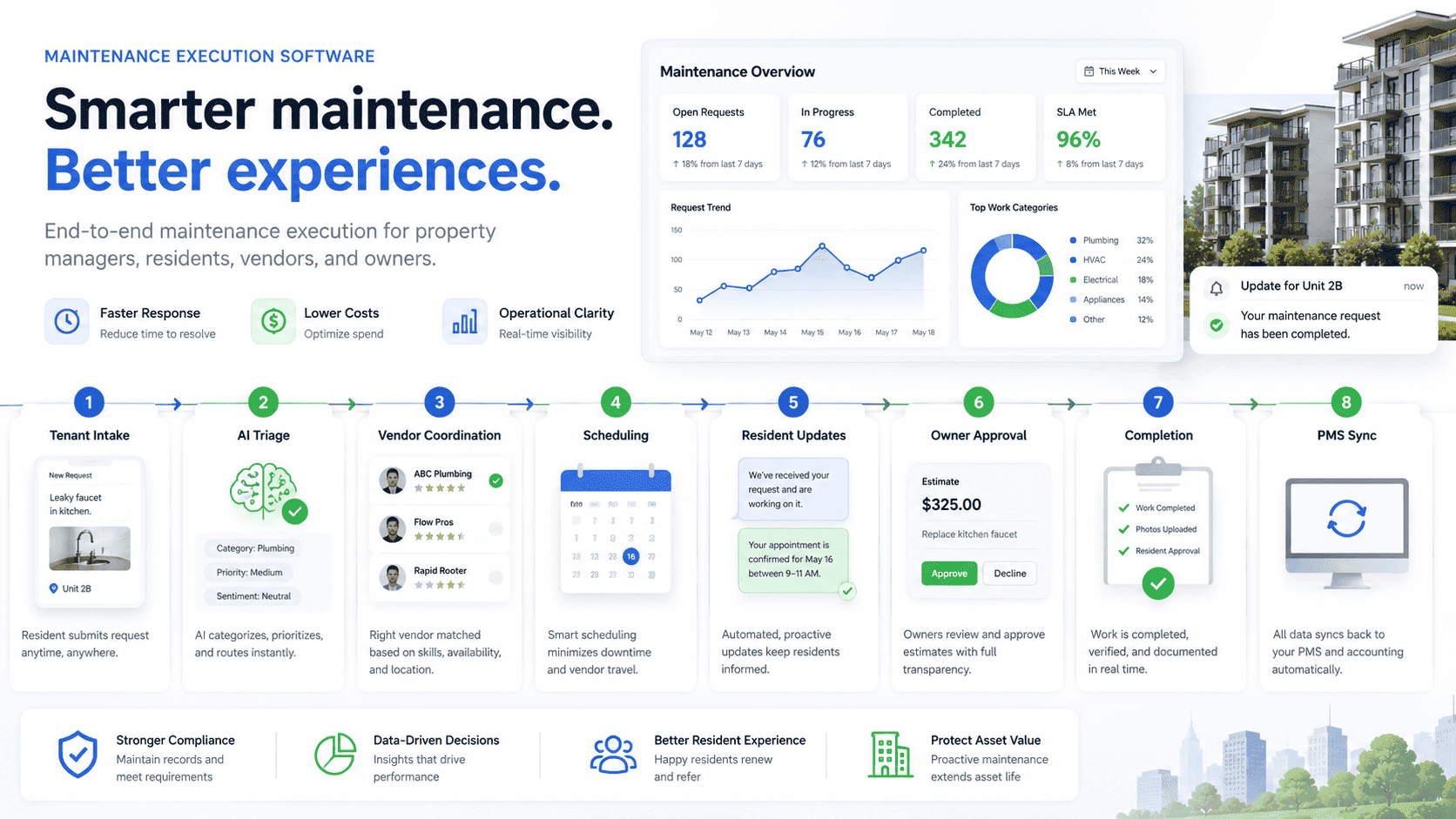
Quick Answer: What Is Maintenance Execution Software?
Maintenance execution software helps property management teams move maintenance work from request to resolution. Instead of only storing work orders, it helps coordinate the actual work behind each request.
That means asking follow-up questions, finding the right vendor, scheduling the visit, updating the resident, tracking approvals, collecting photos and invoices, and syncing the final status back into the PMS.
For property managers, the goal is simple: fewer stuck work orders, faster response times, better vendor coordination, and less manual follow-up.
Why Property Managers Need More Than Work Order Tracking
Most property management companies already have software for maintenance. They may use AppFolio, Buildium, Yardi, Rent Manager, Propertyware, Property Meld, spreadsheets, email, and phone calls.
Even with those systems in place, maintenance often still depends on manual execution. Someone has to read the request, understand the problem, decide what to do next, contact the vendor, chase the reply, and keep the resident informed.
That is the gap maintenance execution software is built to solve.
Traditional systems help property managers record maintenance. Maintenance execution software helps property managers move maintenance forward.
For the broader systems context, read our Property Management Software vs AI Execution guide.
What Does Maintenance Execution Mean?
Maintenance execution means the work that happens after a maintenance request is submitted.
It includes understanding the maintenance issue, deciding whether it is urgent, creating or updating the work order, finding the right vendor, contacting the vendor, scheduling the visit, updating the resident, getting owner approval when needed, collecting quotes and documentation, following up until the job is finished, closing the work order, and syncing the final status back into the PMS.
In other words, maintenance execution is not just about knowing that a work order exists. It is about making sure the work order actually gets done.
Maintenance Execution Software vs Maintenance Management Software
Maintenance management software usually helps teams organize maintenance data, work orders, assets, vendors, and communication. Maintenance execution software goes a step further.
It helps the team take action.
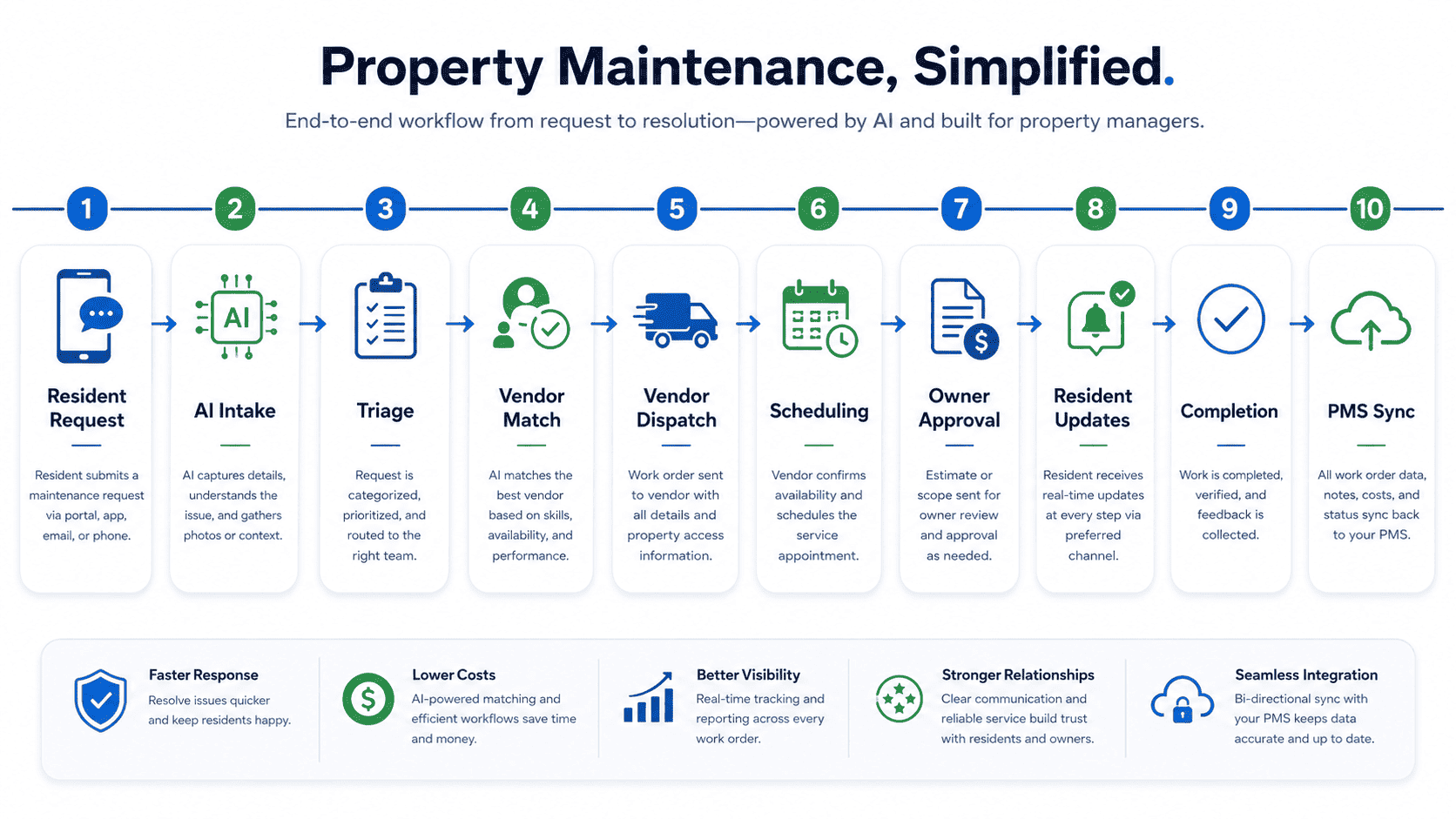
- Maintenance management software: organize and track maintenance
- Maintenance execution software: move maintenance work forward
- Maintenance management software: system of record
- Maintenance execution software: system of action
Why Maintenance Execution Breaks Down in Property Management
Maintenance breaks down because every request depends on multiple people and multiple systems.
A typical request may involve the resident, the property manager, the maintenance coordinator, the vendor, the owner, the accounting team, the PMS, the resident portal, email, phone calls, text messages, photos, quotes, invoices, and approval limits.
The more units a company manages, the harder this becomes. At 100 units, a manager may still handle many requests manually. At 500 units, manual coordination becomes harder to control. At 1,000+ units, maintenance often becomes a full operational department.
The problem is not only the number of work orders. The problem is the number of follow-ups attached to each work order.
The Main Problems Maintenance Execution Software Solves
Maintenance execution software is most valuable when it removes the coordination drag that slows every ticket down.
For the vendor-side bottleneck, see our Vendor Coordination for Property Managers guide.
For the PMS integration angle, read our How Property Managers Automate Maintenance with AppFolio, Buildium, and Yardi guide.
- Slow first response: requests sit unanswered after hours or during busy periods.
- Poor triage: urgent issues are not separated from routine requests quickly enough.
- Manual vendor coordination: vendors are contacted, re-contacted, and updated by hand.
- Missed follow-ups: the next step gets missed and the request stalls.
- Resident status complaints: residents keep asking for updates because nobody communicated clearly.
- PMS data gaps: completion notes, photos, and vendor updates never make it back to the system of record.
What Maintenance Execution Software Should Do
Good maintenance execution software should help with the full maintenance workflow, not just one piece of it.
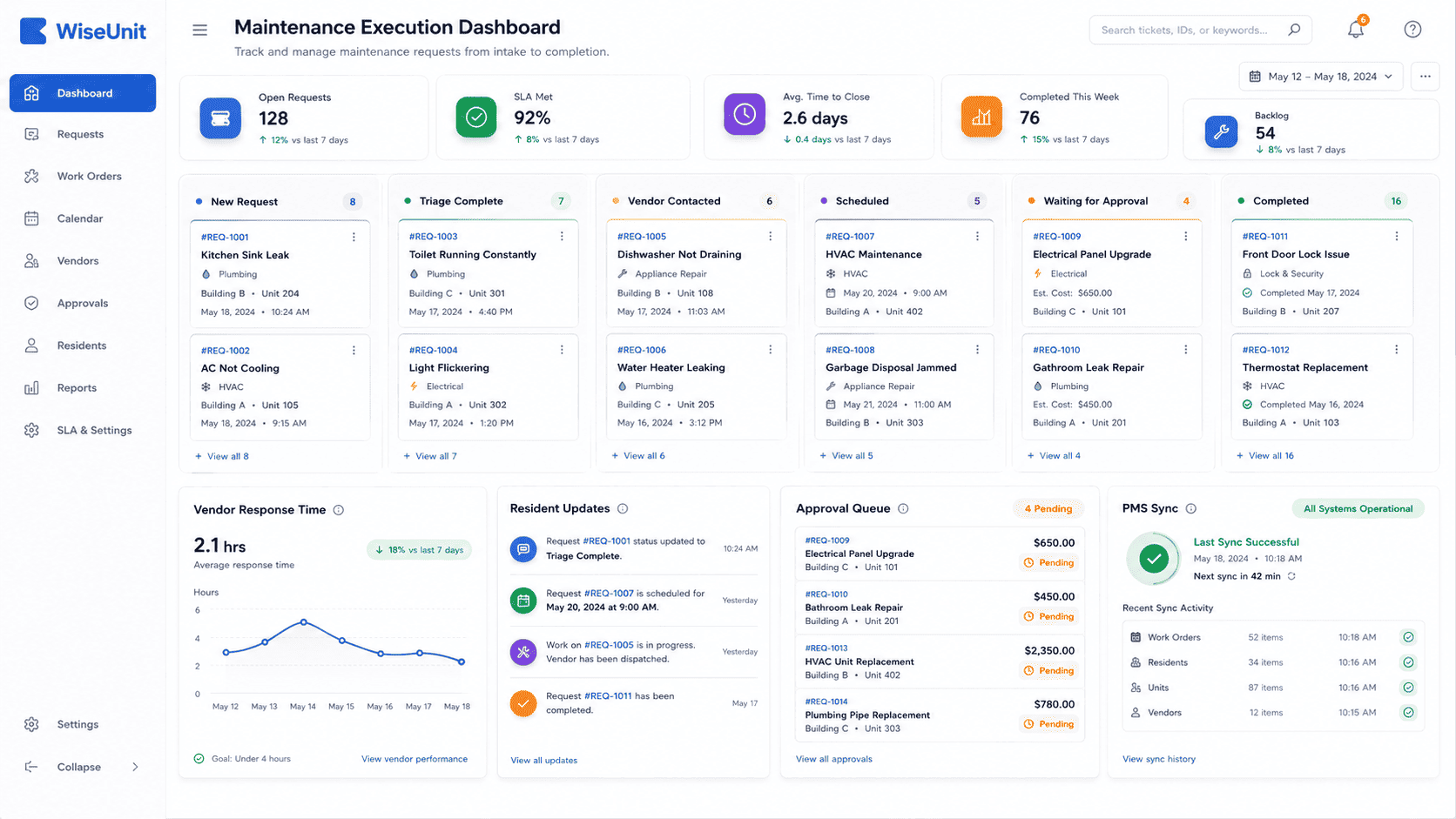
- Maintenance request intake from residents
- AI triage and categorization
- Vendor matching based on issue type, location, and availability
- Vendor dispatch and follow-up
- Scheduling coordination
- Resident updates at each step
- Owner approval workflows
- Documentation and PMS sync
Maintenance Execution Software Workflow Example
A modern maintenance execution workflow starts the moment a resident submits a request and continues until the PMS is updated with the final outcome.
If you want the broader operating model, read our WiseUnit maintenance execution layer guide.
- 1. Resident submits a request
- 2. The system collects more information
- 3. The request is categorized
- 4. The right vendor is selected
- 5. Vendors are contacted
- 6. The appointment is scheduled
- 7. Owner approval is requested if needed
- 8. The resident receives updates
- 9. The job is completed
- 10. The PMS is updated
Maintenance Execution Software vs AI Maintenance Coordinator
These terms are related, but they are not the same. Maintenance execution software is the broader category. An AI maintenance coordinator is one type of maintenance execution software.
In simple terms, an AI maintenance coordinator can be part of maintenance execution software.
For a people-versus-AI comparison, see AI Maintenance Coordinator vs Human Maintenance Coordinator.
- Maintenance execution software: broader category
- AI maintenance coordinator: AI-based role or agent
- Maintenance execution software: can include vendor coordination, approvals, and PMS sync
- AI maintenance coordinator: can assist with intake, triage, dispatch, scheduling, updates, and follow-up
Maintenance Execution Software vs CMMS
A CMMS is common in facilities, manufacturing, healthcare, education, and asset-heavy industries. It usually focuses on assets, equipment, preventive maintenance, inspections, parts, technician workflows, compliance, and work orders.
Property management maintenance is different because the workflow is communication-heavy. Teams are coordinating residents, vendors, owners, and property staff, not only assets.
That is why property managers often need a more communication-heavy execution layer than a traditional CMMS provides.
- Resident requests
- Vendor coordination
- Owner approvals
- Unit-level work orders
- PMS sync
- Resident communication
Who Needs Maintenance Execution Software?
Maintenance execution software is especially useful for property management companies that manage 200+ units, have high maintenance volume, use AppFolio, Buildium, Yardi, or another PMS, and still coordinate manually.
It is also a fit for teams with overloaded coordinators, too many open or delayed work orders, after-hours request pressure, repeated resident status complaints, or a desire to grow without adding headcount at the same rate.
- Multifamily property managers
- Single-family rental managers
- Mixed residential portfolios
- Teams using AppFolio, Buildium, Yardi, or other PMS platforms
- Growing companies that do not want to hire another coordinator
Signs Your Team Needs Maintenance Execution Software
You may need maintenance execution software if your team keeps saying the same things over and over: we have too many open work orders, the vendor never replied, the resident keeps asking for updates, we are waiting on owner approval, nobody updated the PMS, or maintenance is slowing down our growth.
- Too many open work orders
- Vendor response delays
- Repeated resident status checks
- Approval bottlenecks
- Incomplete PMS records
- Overloaded coordinators
Benefits of Maintenance Execution Software
The biggest benefit is scale. Without execution software, more units usually means more calls, more emails, more follow-up, and more operational drag.
- Faster maintenance response
- Less manual follow-up
- Better resident communication
- Better vendor accountability
- Cleaner PMS records
- More scalable operations
How Maintenance Execution Software Improves ROI
ROI usually comes from manual hours saved, delayed hiring, faster resolution, fewer stuck work orders, and better operational visibility.
The more repetitive coordination your team handles, the more valuable maintenance execution software becomes.
- Manual hours saved
- Delayed hiring
- Faster resolution
- Fewer stuck work orders
- Better operational visibility
Example: Before and After Maintenance Execution Software
Before: a resident submits a request, the coordinator reads it, asks follow-up questions, creates the work order, looks for a vendor, sends messages, waits for a response, follows up later, updates the resident manually, checks approval rules, emails the owner, waits again, updates the PMS, and repeats the process across dozens of open requests.
After: the system collects missing information, categorizes the issue, checks urgency, contacts the right vendor, sends resident updates, routes owner approval if needed, follows up on delays, and keeps the work order status updated while the human team handles exceptions and higher-value judgment calls.
What to Look for in Maintenance Execution Software
A dashboard is useful, but execution requires action. The software should not just show what still needs to be done. It should help move the work forward.
- Maintenance intake
- AI triage
- Vendor coordination
- Resident communication
- Scheduling
- Approval routing
- Escalation rules
- PMS integration or sync
- Reporting
- Audit trails
Mistakes to Avoid When Choosing Maintenance Execution Software
The biggest mistakes are choosing another dashboard, ignoring vendor coordination, replacing the PMS instead of extending it, automating without escalation rules, and forgetting the resident experience.
- Choosing another dashboard
- Ignoring vendor coordination
- Replacing the PMS instead of extending it
- Automating without escalation rules
- Forgetting the resident experience
Why WiseUnit Is Maintenance Execution Software for Property Managers
WiseUnit is built for property management teams that want maintenance to move faster without replacing their existing PMS or human team.
It acts as an AI maintenance execution layer that helps coordinate the work behind every maintenance request.
For a deeper look at execution, read our WiseUnit maintenance execution layer article.
- Tenant maintenance intake
- AI triage and categorization
- Urgency classification
- Vendor allocation
- Vendor outreach
- Vendor follow-up
- Scheduling coordination
- Resident status updates
- Owner approval workflows
- Work order documentation
- PMS syncing
- Maintenance reporting
Maintenance Execution Software Is the Future of Property Management Operations
Property management is moving from software that stores information to software that executes workflows.
The better question is no longer where do we track the work order. It is how do we make sure the work order gets completed without constant manual follow-up.
That shift matters because property managers do not only need better records. They need faster action, cleaner communication, better vendor accountability, and less operational drag.
Final Answer: Why Property Managers Need Maintenance Execution Software
Property managers need maintenance execution software because maintenance is not just a tracking problem. It is an execution problem.
A work order sitting in a PMS does not call the vendor. It does not schedule the repair. It does not update the resident. It does not follow up on approvals. It does not collect photos or invoices. It does not close the loop.
Maintenance execution software helps property managers move work from request to resolution.
See How WiseUnit Works
WiseUnit helps property management companies automate maintenance execution without replacing their existing team or PMS.
If your team is spending too much time chasing vendors, updating residents, managing approvals, and manually moving work orders forward, WiseUnit can show you what maintenance execution software looks like inside your workflow.
Frequently asked questions
What is maintenance execution software?
Maintenance execution software is software that helps property management teams move maintenance requests from intake to completion. It can assist with triage, vendor coordination, scheduling, resident updates, approvals, documentation, reporting, and PMS sync.
How is maintenance execution software different from property management software?
Property management software usually stores records, work orders, accounting data, leases, and communication. Maintenance execution software helps move maintenance work forward by coordinating vendors, sending updates, tracking next steps, and helping complete the workflow.
Is maintenance execution software the same as work order software?
Not exactly. Work order software usually helps create, assign, and track work orders. Maintenance execution software goes further by helping coordinate the actions required to complete the work order, such as vendor dispatch, follow-up, resident communication, approval routing, and documentation.
Why do property managers need maintenance execution software?
Property managers need maintenance execution software because maintenance often gets stuck between residents, vendors, owners, coordinators, and the PMS. Execution software helps reduce delays, missed follow-ups, manual communication, and open work order backlog.
What does maintenance execution software automate?
Maintenance execution software can automate or assist with maintenance intake, triage, vendor matching, vendor outreach, scheduling, resident status updates, owner approval workflows, follow-up reminders, reporting, and PMS updates.
Does maintenance execution software replace AppFolio, Buildium, or Yardi?
Usually no. Maintenance execution software is typically designed to work alongside systems like AppFolio, Buildium, and Yardi. The PMS remains the system of record, while the execution software helps move maintenance work forward.
Is maintenance execution software useful for small property management companies?
It can be useful for small teams if they have enough maintenance volume. However, it usually becomes more valuable as a company grows beyond a few hundred units and maintenance coordination becomes repetitive, time-consuming, and difficult to manage manually.
What is the ROI of maintenance execution software?
ROI can come from manual hours saved, faster response times, fewer stuck work orders, delayed hiring, better vendor performance, improved resident communication, and cleaner operational reporting.
Who uses maintenance execution software?
Maintenance execution software is used by property management companies, maintenance coordinators, operations managers, portfolio managers, and real estate teams that need to manage maintenance requests across multiple properties, vendors, residents, and owners.
What should property managers look for in maintenance execution software?
Property managers should look for maintenance intake, AI triage, vendor coordination, resident updates, scheduling, approval routing, PMS integration, reporting, escalation rules, audit trails, and human oversight.