
The Hidden Cost of Vendor Coordination in Property Management Maintenance
A practical breakdown of the hidden labor, cost leakage, and execution drag created by manual vendor coordination in property management.
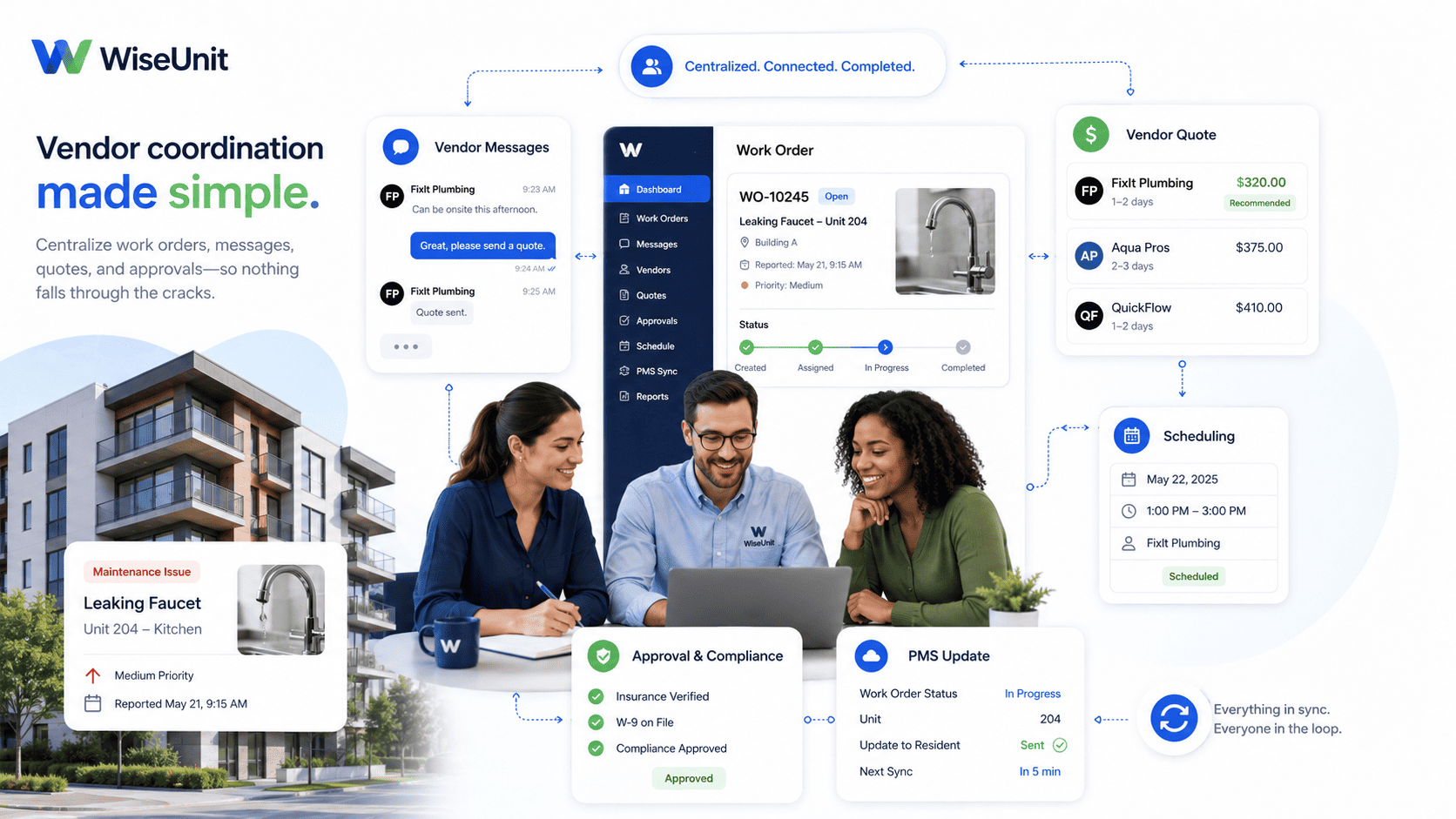
Maintenance Visibility Is Not the Problem
Most property management companies do not have a maintenance visibility problem.
They have a maintenance execution problem.
The work order is already visible. The resident submitted the request. The manager can see it in the PMS. The team knows something needs to happen.
But then the real work starts. Someone has to find the right vendor, send the request, follow up, collect the quote, check compliance, get approval, schedule the job, update the resident, update the owner, and keep the PMS clean.
That is vendor coordination. And it is one of the biggest hidden costs in property management maintenance.
Why Maintenance Coordination Is Getting More Expensive
Maintenance is already a major cost center. The National Apartment Association reported that in 2024, total annual operating expenses reached $8,657 per unit, while repairs and maintenance reached $1,098 per unit. NAA also reported that repairs and maintenance expenses were up 28.2% since 2021.
That means a 4,000-unit property management company could be exposed to more than $4.3 million in annual repairs and maintenance expense, based on that $1,098 per-unit benchmark.
It also means the labor tied to maintenance is large enough that small process improvements matter.
For the bidding side of this workflow, see our multi-bidding in property management maintenance.
What Vendor Coordination Actually Includes
Vendor coordination sounds simple until you break it down.
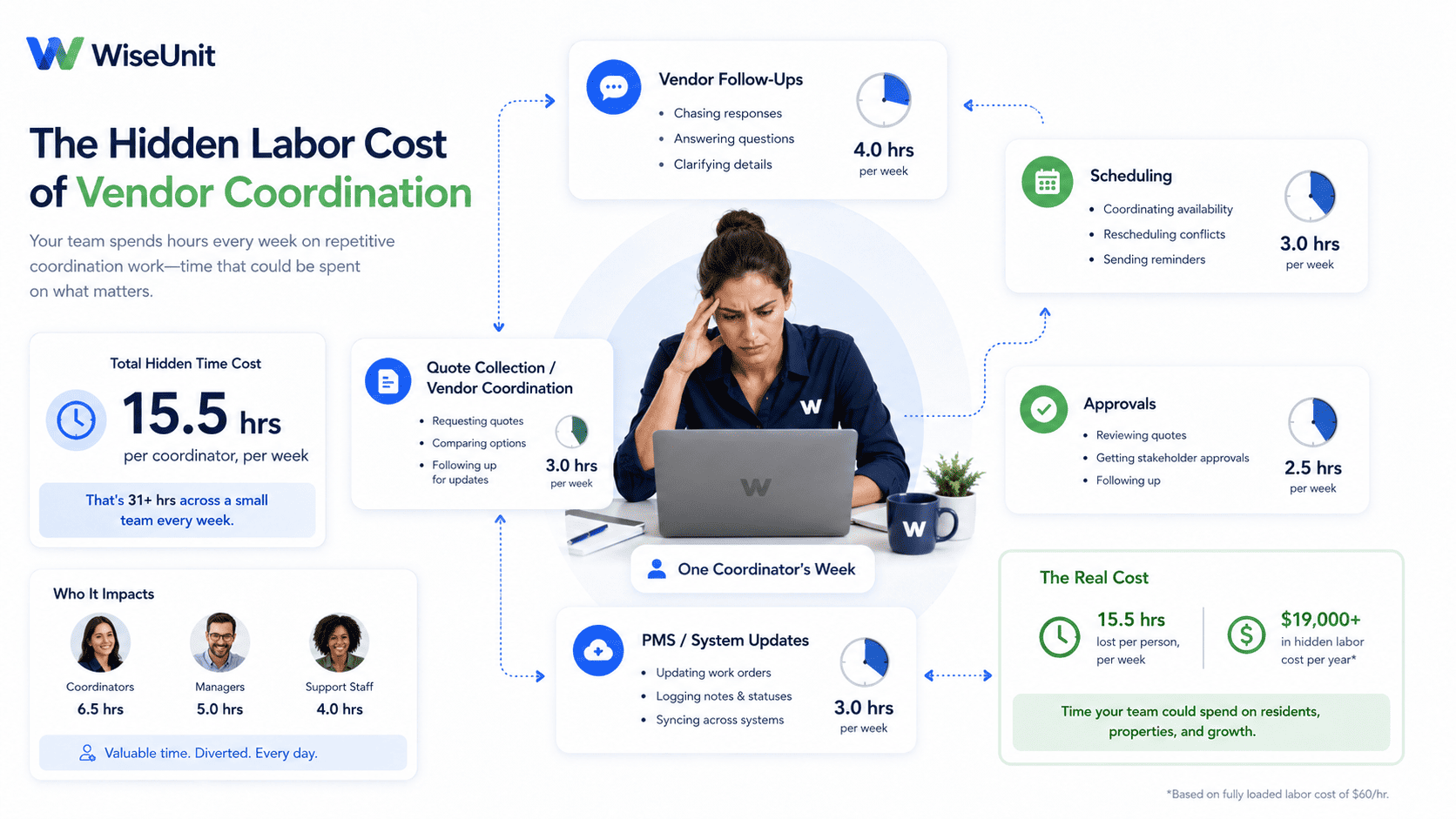
For one maintenance request, your team may need to review the work order, identify the correct trade, decide if the issue is urgent, find an approved vendor, check availability, send the job details, request a quote, follow up if the vendor does not respond, compare scope and pricing, check compliance, request approval, schedule the job, coordinate access, update the resident, update the vendor, update the manager, update the PMS, track completion, handle invoice questions, and close the work order.
That is not one task. That is a full operational loop.
Why Vendor Coordination Becomes Expensive at 1,000+ Units
At 200 units, manual vendor coordination is annoying. At 1,000 units, it becomes a real operations burden. At 4,000 units, it can become a full-time workload spread across several people.
The Bureau of Labor Statistics says property, real estate, and community association managers often arrange repairs, contract for maintenance services, and need organizational skills to coordinate multiple contractors across multiple properties.
The PMS may show the work order. But people still have to move it forward.
The Hidden Labor Math
Lets make the assumptions transparent. BLS reported the 2024 median annual wage for property, real estate, and community association managers at $66,700. It also reported $48,620 for general maintenance and repair workers, and $46,320 for office and administrative support occupations.
Now imagine a 4,000-unit company where two coordinators spend most of their time chasing vendors, two managers spend 25% to 40% of their week on follow-ups and approvals, and one support person helps with scheduling, updates, invoices, and PMS cleanup.
Even with conservative wage assumptions, the labor tied to vendor coordination can easily become a six-figure operational cost.
The Work Order Is Not the Work
This is where many property management companies get stuck. They think the work order is the unit of work. But the work order is only the container.
The real work is everything around it. A work order that says leaky kitchen faucet still needs a vendor, a quote, a decision, approval, scheduling, resident access, completion tracking, invoice review, and PMS updates.
If the vendor does not reply, the job stalls. If the quote is too high, someone needs to get another one. If compliance is expired, someone needs to check it.
Why Your PMS Does Not Fully Solve Vendor Coordination
Your PMS is important. AppFolio, Buildium, Yardi, Rent Manager, Vantaca, and other systems help property managers track work orders, residents, units, owners, vendors, and payments.
But tracking work is not the same as executing work. A PMS can show that a work order is open. It does not always chase the vendor, request bids, compare quote fairness, check compliance, follow up with the resident, or push the job forward when someone forgets.
Why Vendor Coordination Creates More Cost Than Teams Realize
Manual coordination creates cost in three ways. Direct labor cost comes from people spending hours chasing vendors, requesting quotes, sending reminders, and updating systems. Vendor cost leakage happens when teams use the same vendor again without a consistent quote comparison process. Operational drag comes from delays, missed follow-ups, no-shows, resident complaints, and messy data.
The result is usually not one obvious failure. It is a slow accumulation of friction.
ROI Math: What Vendor Coordination Costs Can Look Like
Assume a property management company spends $1,000,000 per year on maintenance vendor work.
If better vendor coordination, multi-bidding, and quote comparison reduce vendor spend by 5%, that is $50,000 in annual savings. At 10%, that is $100,000. At 20%, that is $200,000.
If WiseUnit costs around $20,000 to $30,000 per year, even a small reduction in vendor spend may pay for the software before counting labor savings.
The Real ROI Comes From Three Areas
The strongest ROI is not only one thing. It comes from three areas working together.
- Labor savings from less manual coordination.
- Vendor cost control from better bidding and quote comparison.
- Operational savings from faster execution and cleaner status updates.
Why AI Is Easier to Implement on the Vendor Side Than the Tenant Side
Many property managers are careful with tenant-facing AI. That is understandable. Tenant communication can be sensitive and a bad answer can create risk.
Vendor coordination is different. A vendor either responded or did not. A quote was submitted or not. Insurance is valid or not. The job is scheduled or not. That makes vendor operations a safer and more practical place to start with AI.
How WiseUnit Reduces Vendor Coordination Workload
WiseUnit acts like an AI vendor operations layer between the work order, the vendor network, the resident, the manager, and the PMS.
It helps property management teams identify the trade needed, classify urgency, dispatch the right vendor, request multiple bids when needed, follow up automatically, compare quotes, check vendor compliance, route approvals, schedule the job, send updates, update the PMS, track completion, and store vendor performance data.
Example Workflow
Here is what a WiseUnit vendor coordination workflow can look like.
- Work order comes in
- WiseUnit identifies the trade and urgency
- WiseUnit selects the vendor path
- WiseUnit contacts vendors
- WiseUnit follows up automatically
- WiseUnit collects and compares quotes
- WiseUnit checks compliance
- WiseUnit routes approval
- WiseUnit schedules the job
- WiseUnit updates the PMS
- WiseUnit tracks vendor performance
Vendor Scoring and Pricing History
Most PM companies have vendor knowledge trapped inside people’s heads. One manager knows which plumber responds fast. Another knows which HVAC vendor tends to overquote. Someone else knows which contractor no-shows.
WiseUnit helps turn vendor activity into vendor intelligence by tracking response time, quote amount, quote accuracy, completion speed, no-shows, compliance status, invoice issues, quality of work, resident complaints, manager feedback, and pricing history by job type and location.
Vendor Coordination Should Not Depend on Memory
Most property management teams do not need more reminders. They need the work to move.
A reminder still requires a person to act. A dashboard still requires someone to chase the vendor. A PMS note still requires someone to update the status.
That is why vendor coordination should not depend on memory. It should be a system.
If you want to compare this with the bidding process, read our multi-bidding in property management maintenance.
Final Takeaway and Next Steps
The result is not just fewer open work orders. The result is better maintenance execution.
WiseUnit helps property management companies automate vendor coordination, dispatch, multi-bidding, quote comparison, scheduling, compliance tracking, approvals, resident follow-ups, and PMS updates.
Ready to see how much vendor coordination is costing your team? Book a WiseUnit demo.
For the bidding side, read our multi-bidding in property management maintenance.
Frequently asked questions
What is vendor coordination in property management?
Vendor coordination is the work required to move a maintenance job from request to completion. It includes vendor selection, dispatch, quote requests, follow-ups, compliance checks, approvals, scheduling, resident updates, PMS updates, and completion tracking.
Why is vendor coordination expensive?
Vendor coordination is expensive because it uses staff time across multiple roles. Property managers, maintenance coordinators, regional managers, admin staff, and maintenance supervisors may all spend time chasing vendors, comparing quotes, scheduling work, and updating systems.
Does WiseUnit replace maintenance coordinators?
No. WiseUnit reduces repetitive vendor coordination work so existing teams can manage more maintenance volume, respond faster, and spend less time chasing vendors manually.
How does WiseUnit help reduce maintenance costs?
WiseUnit helps reduce maintenance costs by making vendor coordination more consistent. It can support multi-bidding, quote comparison, compliance checks, approval routing, scheduling, PMS updates, and vendor pricing history.
Why is vendor-side AI easier to adopt than tenant-facing AI?
Vendor-side AI is often easier to adopt because the workflow is more structured. A vendor responded or did not. A quote arrived or did not. Compliance is valid or expired. Approval is pending or approved.