
Multi-Bidding Property Management Maintenance: A Practical ROI Guide
A practical guide to multi-bidding in property management maintenance and the operational ROI behind better vendor coordination.
Why Maintenance Costs Are Getting Harder to Control
Maintenance costs are getting harder to control not because property managers are careless and not because teams do not care about budgets.
The real issue is time. Most teams do not have enough capacity to collect multiple bids, chase vendors, compare quotes, check compliance, schedule the job, update the resident, request approval, and close the loop inside the PMS.
So the same vendor gets used again. The job gets approved because it is urgent. The quote gets accepted because nobody has time to benchmark it. The work gets done, but the company may quietly overpay.
That is where multi-bidding becomes important. And more importantly, that is where WiseUnit helps.
What Is Multi-Bidding in Property Management Maintenance?
Multi-bidding means requesting quotes from more than one qualified vendor before approving a maintenance job.
Instead of calling one plumber, one HVAC vendor, or one handyman, the property management team collects multiple quotes and compares them.
In a good multi-bid process, the team looks at price, scope of work, response time, availability, compliance status, insurance, licensing, past performance, resident impact, and quality risk.
The goal is not always to pick the cheapest vendor. The goal is to pick the best vendor for the job based on cost, speed, quality, and risk.
- Price
- Scope of work
- Vendor response time
- Availability
- Compliance status
- Insurance
- Licensing
- Past performance
- Resident impact
- Quality risk
Why Most PM Teams Do Not Multi-Bid Consistently
Most property management teams already know multi-bidding is useful. The problem is execution.
To multi-bid one maintenance job properly, someone has to review the work order, understand the trade needed, decide if it is urgent, find the right vendors, send the request, follow up when vendors do not reply, collect quotes, compare scopes, check compliance, ask for approval, schedule the vendor, update the resident, update the owner or manager, push the status back into the PMS, and track the invoice.
Now multiply that by hundreds or thousands of work orders. That is why multi-bidding often breaks. Not because teams do not want savings, but because the manual workflow is too heavy.
For the broader workflow context, see our Vendor Dispatch Automation guide.
How Much Can Property Managers Save With Multi-Bidding?
There is not enough public, property-management-specific data that says multi-bidding saves exactly a fixed percentage on apartment maintenance, so it is important to be careful.
That said, there is strong adjacent evidence from procurement, public bidding, facilities management, and sourcing research that competitive bidding and better vendor competition can reduce prices.
The lesson for property management is simple: when teams consistently compare qualified vendors instead of relying on one default option, they have a better chance of controlling cost.
- Competitive bidding can lower prices when vendors genuinely compete.
- Adding one more bidder can create meaningful price pressure.
- Better bidder access and better process transparency can reduce friction.
- The goal is enough competition, not endless vendor churn.
ROI Math: What 5%, 10%, and 20% Savings Look Like
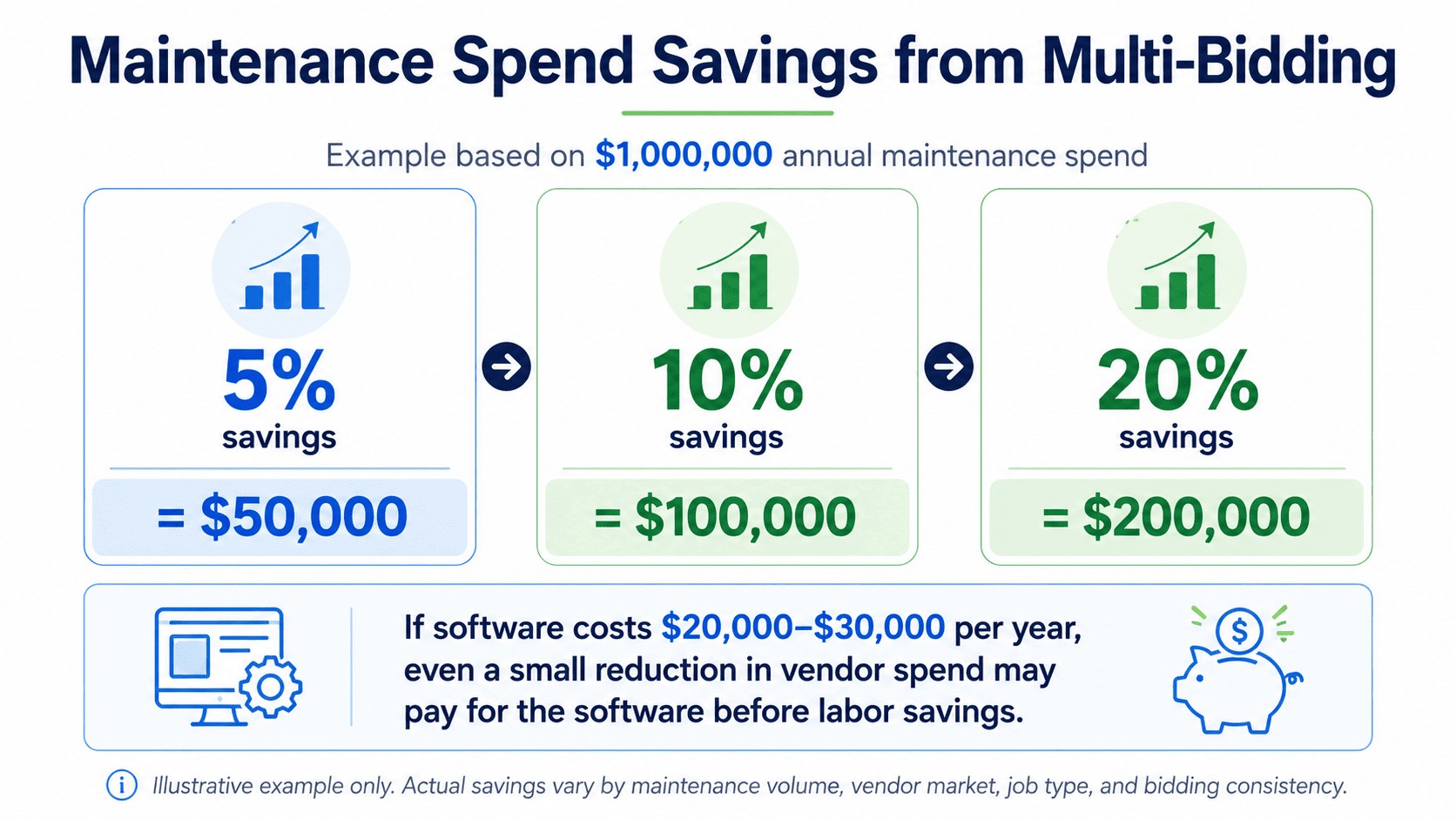
Let's use a simple example. Assume a property management company spends $1,000,000 per year on maintenance vendor work.
At that spend level, even modest savings can become meaningful quickly.
If you want to model your own numbers, use our ROI calculator.
- 5% savings = $50,000 in annual savings
- 10% savings = $100,000 in annual savings
- 20% savings = $200,000 in annual savings
The Hidden Labor Cost of Vendor Coordination
Vendor coordination is expensive because it eats team capacity. A 4,000-unit property management company may have several people involved in vendor follow-ups, quote collection, scheduling, compliance workflows, approvals, and PMS updates.
Even if the company does not hire people with the title vendor manager, the work still exists. If the blended fully loaded cost of that time is only $150,000 to $250,000 per year, and WiseUnit reduces a meaningful portion of the repetitive work, the labor ROI becomes very clear.
- Maintenance coordinators spend time on vendor follow-up.
- Regional and property managers spend time on approvals and exceptions.
- Operations staff spend time on updates and scheduling.
- Manual work grows with every additional ticket.
Where the ROI Really Comes From
Multi-bidding is not only about cheaper quotes. The ROI usually comes from three areas.
- Vendor cost savings from better quote comparison and less reliance on one default vendor.
- Labor savings from reducing manual vendor coordination.
- Operational savings from faster dispatch, fewer delays, and fewer jobs sitting untouched.
Why AI Is Easier to Implement on the Vendor Side Than the Tenant Side
Many property managers are careful with tenant-facing AI, and that makes sense because resident communication can be sensitive.
Vendor coordination is different. The vendor side is more operational, repetitive, structured, and easy to validate. A vendor either responded or did not. A quote was submitted or not. Insurance is valid or not.
That makes vendor operations a better first place to apply AI in many property management companies. The AI does not need to replace human judgment. It needs to remove the repetitive coordination work around that judgment.
How WiseUnit Automates Vendor Coordination and Multi-Bidding
WiseUnit acts like an AI vendor operations layer between the work order, the vendor network, the resident, the manager, and the PMS.
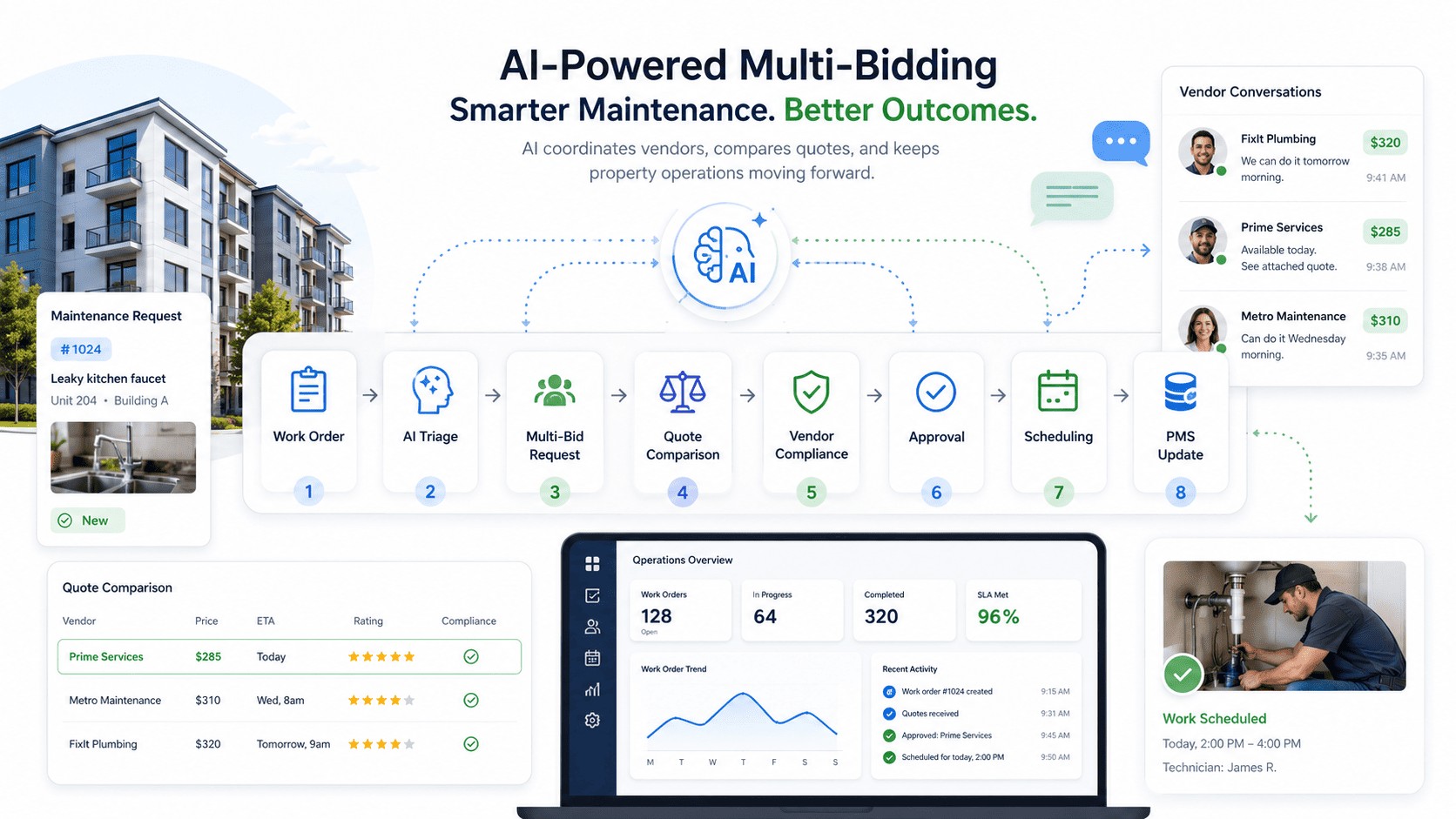
It helps property management teams identify the trade needed, decide if a job needs emergency dispatch or multi-bidding, contact preferred vendors, request multiple quotes, follow up automatically, compare quotes, check vendor compliance, route approvals, schedule the job, update residents, update vendors, update the PMS, track job status, and build vendor performance history.
The difference is that the team does not need to manually chase every step. WiseUnit keeps the work moving.
Example Workflow
Here is what a WiseUnit workflow can look like.
- Work order comes in
- WiseUnit identifies trade and urgency
- WiseUnit dispatches or requests multiple bids
- WiseUnit follows up automatically
- WiseUnit compares quotes
- WiseUnit checks compliance
- WiseUnit requests approval
- WiseUnit schedules the job
- WiseUnit updates the PMS
- WiseUnit tracks vendor performance
Vendor Scoring and Pricing History
Most property management companies have vendor knowledge trapped inside people's heads. Someone knows which plumber responds fast. Someone knows which HVAC vendor overquotes. Someone knows which contractor no-shows.
WiseUnit helps turn vendor activity into vendor intelligence by tracking response time, quote amount, quote accuracy, completion speed, no-shows, compliance status, invoice issues, quality of work, resident complaints, manager feedback, and pricing history by job type and location.
Over time, that gives the company a smarter vendor network and a stronger pricing history for future jobs.
Final Takeaway and Next Steps
Most property management companies do not overpay because they are careless. They overpay because their teams are busy and do not have time to run a perfect vendor process on every job.
Multi-bidding works best when the process is consistent, but consistency is hard when humans have to chase every vendor manually. That is the gap WiseUnit fills.
The result is not just cheaper maintenance. The result is better maintenance execution.
For related context, read our Maintenance Cost guide.
For vendor workflow context, see our Vendor Management guide.
Ready to see where your vendor costs are leaking? Book a WiseUnit demo.
Frequently asked questions
What is multi-bidding in property management maintenance?
Multi-bidding is the process of collecting quotes from multiple qualified vendors before approving a maintenance job. It helps teams compare price, scope, timing, and vendor quality.
Does multi-bidding always mean choosing the cheapest vendor?
No. The cheapest vendor is not always the best choice. A good maintenance bidding process compares price, scope, response time, vendor history, compliance, availability, and quality risk.
How much can property managers save with multi-bidding?
There is no universal savings number. Savings depend on maintenance volume, vendor market, job type, urgency, and how consistently the team collects bids.
Why do property management teams struggle with multi-bidding?
Most teams struggle because the process is manual. Someone has to contact vendors, follow up, collect quotes, compare scopes, check compliance, request approval, schedule the job, update the resident, and update the PMS.
How does WiseUnit help with vendor management?
WiseUnit helps automate vendor coordination, dispatch, multi-bidding, quote comparison, compliance tracking, approvals, scheduling, resident and vendor follow-ups, and PMS updates.