
How Property Managers Can Tell If a Maintenance Quote Is Fair with WiseUnit
A practical guide to maintenance pricing intelligence for property managers who need better context before approving vendor quotes.
Most property managers are not procurement experts
A plumbing vendor sends a quote for $875. Is it expensive? Maybe. Is it fair? You do not know.
That is the problem. The quote usually gets approved because the job has to move forward, not because anyone is sure it is the right price.
Property managers rarely overpay because they are careless. They overpay because they do not have enough context to judge the quote quickly.
- What similar jobs typically cost
- Whether another vendor usually charges less
- Whether prices have increased over time
- Whether the quote is high compared with similar work
- Whether it is worth negotiating before approval
What does it mean for a maintenance quote to be fair?
A fair quote is not always the cheapest quote, and the most expensive quote is not automatically overpriced.
A fair quote reflects the work being performed, the urgency of the repair, local market conditions, and the vendor's quality and reliability.
Emergency after-hours work will naturally cost more than scheduled daytime maintenance, and a high-performing licensed contractor may be worth a premium.
For the broader bidding context, read our Multi-Bidding Property Management Maintenance ROI guide.
Why maintenance pricing is so difficult
Unlike office supplies or software, maintenance pricing changes constantly.
The same repair can cost different amounts because of location, labor availability, emergency response, building age, equipment brand, material costs, vendor specialization, and seasonality.
Even within the same city, two vendors may quote very different prices for almost identical work, and that does not automatically mean one is wrong.
- Location
- Labor availability
- Emergency response
- Building age
- Equipment brand
- Material costs
- Vendor specialization
- Seasonality
The hidden cost of approving quotes without context
Every maintenance quote creates a decision: approve it, negotiate it, or request another bid.
Many teams rely on trust, memory, urgency, or guesswork because they are moving too fast to investigate every quote properly.
That is not poor management. It is a lack of pricing intelligence.
- Trust tells you a vendor has worked well before, but not whether today's quote is competitive.
- Memory is incomplete and gets weaker as teams change.
- Urgency is real, but not every quote should be treated like an emergency.
- Guesswork is common when managers do not have time to benchmark pricing.
Multi-bidding helps, but it does not solve everything
Competitive bidding can reduce vendor costs and improve accountability, but multiple quotes alone do not tell you whether the market price is fair.
If all three quotes are high, you still need historical context to know whether they are reasonable.
That is where maintenance pricing intelligence becomes valuable.
- Multi-bidding helps collect competing quotes.
- Pricing intelligence helps evaluate those quotes against historical and comparable work.
- A quote can be the lowest and still be too high.
- Three expensive quotes do not automatically equal a fair market price.
Introducing maintenance pricing intelligence
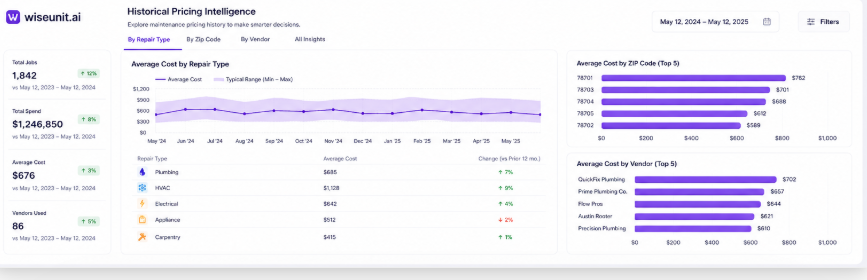
Maintenance pricing intelligence answers one simple question: how does this quote compare to similar work?
Instead of only looking at today's bid, WiseUnit looks at the bigger picture: historical pricing, comparable jobs, vendor pricing trends, job type, urgency, location, previous invoice amounts, and vendor performance history.
That gives managers a much better decision frame than a single quote can provide on its own.
Every completed work order should make the next decision smarter
Every maintenance job creates valuable information: what the vendor charged, how long the work took, whether the quote matched the invoice, whether change orders happened, and whether residents were satisfied.
Most companies lose that information when the invoice gets paid and the work order gets closed.
WiseUnit treats every completed job as another data point that improves future maintenance decisions.
- Quote amount
- Invoice amount
- Response time
- Completion time
- Change orders
- Resident satisfaction
From vendor history to vendor intelligence
Most property management companies already have years of maintenance history, but it is scattered across the PMS, invoices, email threads, and individual memory.
WiseUnit brings those pieces together so every previous job can inform the next one.
That creates vendor intelligence, not just a vendor list.
What is vendor intelligence?
Vendor intelligence is more than knowing who your vendors are. It means understanding how they perform over time.
A strong vendor profile can show average quote amount, average invoice amount, response time, completion time, emergency availability, quote acceptance rate, change order frequency, resident satisfaction, compliance status, number of completed jobs, and pricing trends by repair type.
- Average quote amount
- Average final invoice amount
- Response time
- Completion time
- Quote acceptance rate
- Change order frequency
- Resident satisfaction
- Compliance status
The difference between vendor management and vendor intelligence
Vendor management stores information such as names, contact details, insurance, licensing, categories, and preferred status.
Vendor intelligence answers operational questions: Is this vendor getting more expensive? Are they charging more than similar vendors? Are invoices consistently higher than the original quote? Do they respond faster than everyone else?
Management stores data. Intelligence creates insight.
What happens when a new quote arrives?
Imagine a plumbing vendor submits a quote for kitchen drain repair at $865.
Most teams would approve it because the job needs to get done. WiseUnit instead compares the quote against similar plumbing jobs, property type, job complexity, ZIP code, emergency or scheduled work, historical invoices, vendor history, and comparable maintenance pricing.
The goal is not to replace the manager. The goal is to give the manager more context before making a decision.
- Similar plumbing jobs
- Property type
- Job complexity
- ZIP code
- Emergency or scheduled work
- Historical invoices
- Vendor history
- Comparable maintenance pricing
Quote fairness, not quote guessing
Property managers should not have to guess whether a quote is reasonable.
Every quote should answer simple questions: Is this within the normal range? Is this vendor charging significantly more than usual? Has pricing increased over the last year? Should we request another quote?
That is quote fairness.
Using anonymized maintenance pricing benchmarks
WiseUnit is not designed to expose another company's private maintenance data.
The long-term vision is to build anonymized maintenance pricing benchmarks that help managers understand historical pricing patterns, regional pricing trends, comparable job pricing, vendor cost intelligence, and quote fairness without exposing confidential information.
The value is not knowing exactly what one competitor paid. The value is knowing what comparable work typically costs.
Historical pricing becomes negotiation leverage
Today, many negotiations sound like, 'Can you lower the price?' That is not a great starting point.
Historical pricing intelligence creates a better conversation because the manager can reference comparable jobs and actual ranges instead of relying on memory.
That keeps the negotiation informed, not emotional or confrontational.
- We have completed similar repairs in this market within a known range.
- Comparable jobs have historically landed closer to a lower number.
- Emergency labor or special parts may justify a higher price.
- The goal is not the lowest price on every job, but better conversations.
Maintenance pricing intelligence gets smarter over time
The first year of maintenance data is useful. The second year is better. By the third year, the company has built one of its most valuable operational assets: maintenance intelligence.
Over time, every category becomes more predictable because the company understands the way prices change instead of reacting to them one invoice at a time.
- Electrical repair cost patterns
- Plumbing emergency surcharges
- HVAC replacement pricing
- Turn completion costs
- Painting and flooring trends
- Roof repair and lock change patterns
Vendor pricing trends
Historical pricing also answers another important question: is this vendor becoming more expensive?
If prices drift upward slowly over five years, it is easy to miss when each invoice is reviewed in isolation.
WiseUnit helps teams see the relationship, not just the receipt.
ROI example
If a company spends $1,000,000 annually on maintenance vendors, even modest quote improvements can matter.
The exact savings depend on maintenance volume, market conditions, vendor competition, repair category, bidding consistency, and historical pricing available.
If WiseUnit costs about $20,000 to $30,000 annually, relatively small reductions in unnecessary vendor spend may cover the software before labor savings are even considered.
The real ROI comes from three areas
Maintenance pricing intelligence creates value in three different ways.
- Better pricing decisions because managers know whether pricing looks reasonable before work begins.
- Better negotiations because teams can use comparable maintenance intelligence instead of asking for discounts blindly.
- Better long-term vendor strategy because the company can see which vendors consistently deliver the best value.
WiseUnit workflow: From quote to pricing intelligence
A typical workflow starts when a work order enters WiseUnit from the PMS.
A vendor submits a quote, WiseUnit analyzes it against historical pricing and comparable work, the manager gets a quote fairness review, and if appropriate the team negotiates or requests another quote before final approval.
After the job is completed, the result becomes another data point that makes future pricing decisions smarter.
- Work order arrives
- Vendor submits a quote
- WiseUnit analyzes the quote
- Quote fairness review
- Optional negotiation
- Manager approval
- Job completed
- Historical pricing updated
Vendor scoring: every maintenance job should improve your vendor network
Pricing is only one piece of the puzzle. The cheapest vendor is not always the best vendor.
WiseUnit helps build a performance profile for each vendor so teams can see response time, quote amount, final invoice amount, completion speed, no-shows, compliance status, invoice disputes, change order frequency, resident feedback, and pricing history by repair type and ZIP code.
The future of maintenance pricing intelligence
Property management has moved from online portals to digital work orders to cloud-based PMS platforms. The next step is operational intelligence.
The goal is not to replace human experience. It is to combine experience with historical pricing intelligence so every maintenance decision is more informed.
Why this matters for growing property management companies
As portfolios grow, maintenance decisions become harder because knowledge gets fragmented across regions, managers, and properties.
Without a centralized intelligence layer, every office starts operating independently. WiseUnit helps standardize maintenance knowledge across the organization so every completed job contributes to one growing intelligence layer.
Maintenance intelligence becomes a competitive advantage
Two companies can receive the same plumbing quote and make very different decisions depending on the information they have.
The advantage is not having better people. The advantage is having better information.
That is the future WiseUnit is building.
Better decisions compound over time
One maintenance quote rarely changes a business, but thousands of maintenance decisions every year absolutely do.
Small improvements repeated over and over become meaningful. That is why maintenance pricing intelligence matters: it improves every repair after the first one.
Property managers should not have to guess
Property managers already have enough to do. They should not have to wonder whether a quote is too high, search old invoices, or remember what another vendor charged two years ago.
Maintenance pricing should get smarter over time, and every completed work order should improve the next decision.
That is the vision behind WiseUnit.
If you want to estimate the business impact, try our ROI calculator.
Ready to make maintenance pricing smarter?
WiseUnit helps property management companies automate vendor coordination, compare maintenance quotes, build historical pricing intelligence, track vendor performance, and create a smarter maintenance operation over time.
Book a WiseUnit demo or request a Maintenance Pricing Intelligence Assessment to see how your maintenance data could become one of your biggest operational advantages.
To see the workflow in practice, book a demo.
Frequently asked questions
What is maintenance pricing intelligence?
Maintenance pricing intelligence uses historical maintenance data, comparable jobs, vendor performance, and pricing history to help property managers understand whether a quote is within a reasonable range.
How is maintenance pricing intelligence different from multi-bidding?
Multi-bidding helps collect multiple quotes. Maintenance pricing intelligence helps determine whether those quotes are actually reasonable by comparing them with historical and comparable maintenance work.
Does WiseUnit know what competitors are paying?
No. WiseUnit is designed around anonymized maintenance pricing benchmarks, historical pricing intelligence, and comparable maintenance data, not private competitor information.
Can maintenance pricing intelligence reduce maintenance costs?
Potentially, yes. By helping managers identify unusually high quotes, negotiate with better information, and improve vendor decisions over time, maintenance pricing intelligence may contribute to lower maintenance spend.
Does WiseUnit replace maintenance managers?
No. WiseUnit supports maintenance managers by providing better information before decisions are made, while managers remain in control of approvals, vendor relationships, and operational decisions.